Showing posts with label The Galactic Center series. Show all posts

Wednesday, April 17, 2024

Book Review - Sailing Bright Eternity

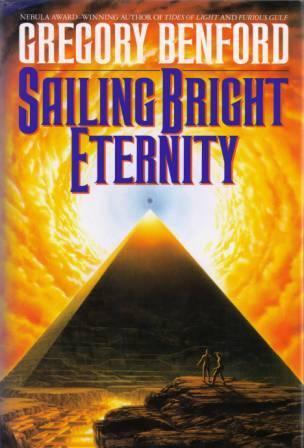
book cover for Sailing Bright EternityIf you made it this far into the series, congratulations. Whether or not you'll like how it ends is a bit of a coin toss.

We learn that the old man at the end of Furious Gulf is none other than Nigel Walmsley. Someone how the jerk protagonist from the first two books managed to survive some 30,000+ years (time dilation and really advanced technology helped) and is now present to help Toby escape the Mechanicals that have been pursuing him. So the first solid chunk of the book is a flashback of Nigel's life since arriving here at the Galactic Center. Amazingly enough, the man changed! He's gone from being a jerk to a curmudgeon. Yes, that's an improvement. He's been humbled by marriage and parenthood, not to mention the discoveries made at the Galactic Center and how humanity fits into the galactic pecking order. But loss probably shaped him the most. This Nigel I liked, but I couldn't help but feel that the guy is a stand-in for Benford himself.

But the Mechanicals get the upper hand, errr appendage, and Toby is off on his own, wandering through those volatile estys again, trying to find his father or, at least, other Bishops. At one point, the whole thing transforms into the sci-fi adventures of Huckleberry Finn on the space-time-river equivalent of the Mississippi. I really wondered where Benford was going with this. It had its moments but it seemed like a distraction. Ultimately, this section comes to an abrupt end, and Toby is reunited with Killeen.

There's a final showdown with the Mantis, which was needed as the thing was responsible for so much suffering. The method of resolution was unexpected, but fitting. Afterwards, there's a bit of a long epilogue as we see glimpses of our main characters' lives. I found it to be a bit sad. There is no "happily ever after," but there is an after. And the takeaway borrows thematically from Shakespeare:
All the world's a stage,
And all the men and women merely Players;
Benford could be considered guilty of meandering around with metaphysical speculation about higher lifeforms, but I can forgive him for that. We humans have this arrogance that the world—you could argue the universe—revolves around us. We are blissfully ignorant of older and far more advanced lifeforms in the universe, and our narcissism boasts that they don't exist because we don't have proof of them having visited us, as if we were so special that we merited being fawned over. It's a conceit that Benford doesn't ascribe to.

3.75 stars

\_/
DED

Wednesday, January 31, 2024

Book Review: Furious Gulf

book cover for Furious GulfTrying to escape the relentless mechs, the last humans from the planet Snowglade take their ancient starship on a dangerous course straight into the Eater, the black hole at the galactic center. Hungry and desperate, the refugees begin to question the leadership of Captain Killeen, who believes the center holds their one hope of survival. Meanwhile, Killeen's son Toby struggles with the microchips that were implanted in his spine—a technology that now threatens his sanity. Caught between their genocidal pursuers and peril in the galactic center, Killeen and Toby bring humanity to its final destiny.

So this chapter in the Galactic Center saga is told from Toby's POV. Life isn't easy for the son of a captain. He wants to talk son-to-father, but too often it's in front of the crew, so it winds up sounding like an out-of-line ensign sowing discord. And when it seems like they're talking father-to-son, Killeen reverts back to captain-to-crew. The reason for that is Toby is carrying around the personality of his father's dead girlfriend, Shibo, on a chip mounted into his internal computer system. Killeen claims that it's because she was an important member of the crew with valuable skills, but Toby thinks Dad just can't let go. They're both right.

In the hierarchy of dead people stored on computer chips, personalities are at the top. They take up a lot of memory and, given enough time, can override their host. And that's what Shibo starts to do.

After a hellish trip through the high energy physics equivalent of Scylla and Charibdis, the Argo arrives at an odd oasis in some kind of balanced region within the maelstrom, a bit like a Lagrange Point but with space-time at work instead of gravity. Interacting with the people there is odd, and there is much confusion between the two parties with the locals using home field to their advantage rather than trying to help their distant cousins.

In the midst of negotiations, Toby has an outburst which complicates matters. Killeen tosses him into the brig. When Toby gets word of what transpired in his absence, he feels like he was setup. Toby runs away with Quath, who acts as a guard/guide. They sneak behind the proverbial curtain only to fall into what I think were pocket universes of space and time. Things get a bit strange as Benford plays around with physics at a level I can't pretend to understand. Toby finds himself on his own, struggling to deal with Shibo's needy disembodied personality, the weirdness of the landscape he finds himself in, coming of age as an adult, and being pursued by malevolent entities.

At my age, I'm not really into coming of age stories, but when Benford doesn't make the story all about Toby, it holds up. The exploration of around the galactic center made for some entertaining reading. I wouldn't have minded more of that. But I struggled with the physics involved getting near the core and Toby's explorations at the oasis. The conflicts are kind of resolved, but not really, and the ending is something of a cliffhanger. Still, if you've made it this far into the series, you have to go all the way.

3.75 stars

\_/
DED

Friday, December 15, 2023

Book Review: Tides of Light

book cover for Tides of LightGalactic Center series book #4.

Piloting an ancient starship, Killeen and the Bishop tribe escape the mech-ruled world of Snowglade. Seeking refuge on a far away planet, they discover vast wonders: an organic life-form as large as a world, a planet-coring cosmic string, a community of humans ruled by a brutal tyrant, and ultimately an alien race more awesome than any they have encountered. As they battle for survival against these myriad dangers, Killeen and his crew will gain an unforeseen ally—one that may determine humanity's true destiny...

This series continues to improve. Tides of Light builds on the series course correction that was Great Sky River. The book blurb summarizes the story pretty well. Whereas Great Sky River laid the groundwork for where the series now takes place, Tides of Light focuses more on how these tribes of humanity deal with each other and one another. The militaristic hierarchy is more prominent than I remember it being in Great Sky River, but if you're fighting for survival against intractable enemies every day, then I guess war is all you know.

The "alien race more awesome than any they have encountered" refers to the Cybers. I thought that was an odd name choice considering how cybernetically enhanced our Humans are here. But if you compare the two, the Humans are entry level cyborgs compared to these new aliens. And Benford does a great job of giving us their POV, particularly through the alien known as Quath. They look down on the Humans as being mere animals, but Quath comes to realize that they're something more.

The way the "organic life-form as large as a world" was introduced was a bit jarring. It seemed like Benford had gone off on a speculative tangent for the hell of it, but eventually he brought it back around into the story. Killeen's encounter with the planet-coring cosmic string also seemed like a physicist's thought experiment that was conveniently contrived because, well, he's an astrophysicist! Show off! ;-P But in the grand scheme of the story, Benford made it fit.

Speculative science and tech marvels aside, I think that at this point in Benford's career he finally got a good handle on characterization. I finally felt some attachment to these characters rather than being an dispassionate observer of the story's events (or worse). Even the Cyber Quath proved interesting. The tyrant was less so. He was two-dimensional, and it isn't until the end of the novel that we learn why; finding out earlier would've been a spoiler.

Overall, a good blend of speculative ideas and characterization.

4 stars.

\_/
DED

Wednesday, March 25, 2020

Book Review - Great Sky River

book cover for Great Sky RiverGalactic Center series book #3.

According to the timeline in the back of my copy of the book, 35,000 years have passed since the events in Across the Sea of Suns. The survivors of that book were joined by expeditions from Earth in the central region of the Milky Way. Humanity enjoyed a second Renaissance that lasted thousands of years, but it ultimately caught the attention of the Mechanicals, who proceeded to methodically fight a war of attrition against them. Six years ago on the planet Snowglade, where this story takes place, the Mechanicals overwhelmed the Citadels and forced the survivors into a nomadic lifestyle, feeding off the scraps of the fringes of Mechanicals' civilization.

The humans on Snowglade are augmented, their bodies implanted with and connected to so many cybernetic parts that they're vulnerable to electromagnetic attacks and computer virus infections. To compound the problem, the humans on Snowglade have been regressing over the centuries. They've become so dependent on their technology to do everything for them that they no longer possess the knowledge to create anything new. Sure, they can fix some things, but they typically don't seem to be much more than cybernetic cavemen. They can't even understand the information that appears in their HUDs. Distant dead ancestors were digitized, and its every adult survivor's responsibility to carry their share of these personalities around with them in their personal computer memory. But rather than make the most of the knowledge that these digital ancestors still retain, they're often brushed aside because they're annoying.

The story is told from the POV of Killeen, a member of the Bishop family (tribe). His father and wife died when their citadel was destroyed. His son, Toby, is all he cares about now. We witness the raids on Mechanicals' manufacturing outposts and attacks on the family by Marauder machines through his eyes. He comes to realize that the nature of the attacks is changing. There's a machine out there that possesses a cunning, ruthless intelligence that is unlike any Marauder. He names it the Mantis.

The Mantis has taken a perverse interest in humanity, and it is up to Killeen and his tribe to figure out its motives.

Benford has made some dramatic improvements in this series. First off, the arrogant protagonist of the first two novels, Nigel Walmsley, has been pushed into the historical record. Secondly, but no less important, female characters are finally treated as equals. Fanny is the captain of the Bishop tribe at the onset of the story, and Killeen greatly respects her leadership. Shibo is a survivor from another tribe who impresses Killeen with her knowledge and skill. No damsel in distress here.

The dialogue took some getting used to. Benford grants the Snowglade denizens a dialect that comprises several slang words and new terms ("yeasay", "suredead", "mechtalk", etc.) and modifies their grammar to help craft an image of them as hillbillies. That's not meant to be an insult.

There are some scenes in the lair of the Mantis that appear to be inspired by H.R. Giger. In many of his works, Giger blended humans and animals with machines to create disturbing biomechanoid images (the creature in the movie Alien being his most famous work). Benford puts his own spin on the concept. Whether or not the descriptions will disturb the reader is up to said reader's ability to visualize what Benford writes. I give him points for the effort.

While not a reboot of the series, Benford in effect wipes the proverbial slate clean. With a new protagonist and solid supporting cast of characters, the Galactic Center saga takes on a fresh new look.

3.5 stars.

\_/
DED

Monday, June 3, 2019

Book Review: Across the Sea of Suns

book cover for Across the Sea of SunsGalactic Center Saga Book #2.

First, a bit of backstory. I actually started this series, not knowing it was a series, back in the 80s. I'd picked up this book through a sci-fi book club as a teen. Upon reading it, I realized that it wasn't a standalone but a sequel. However, there was enough backstory that it didn't matter. But then the ending was left wide open, so I knew that it was, in fact, a series. I was not amused and subsequently forgot about the series for decades. A couple of years ago I stumbled across the first book of the series at a library book sale and decided that I would read the series from start to finish. Review of the first book, In the Ocean of Night, can be found here.

Decades have passed since the events that transpired in the first book. The alien wreck on the Moon has been reverse engineered to provide humanity with interstellar flight capability (roughly 0.9c). Earlier, a radio signal had been detected from a world (Isis) orbiting Lalande 21185 (Ra). A hollowed out asteroid, dubbed Lancer, has been fitted the new technology from the alien wreck (basically a Bussard Ramjet). Nigel Walmsley, our "hero" from the first book, and his girlfriend, Nikka, have been selected to be on the mission to investigate the source of the radio signal.

Meanwhile on Earth, alien ships have arrived and landed in the oceans, releasing two alien lifeforms, Swarmers and Skimmers. The Swarmers, roughly the size of a great white shark and equipped with sticky proboscises attached to their bellies, are attacking shipping worldwide and, for some reason that I can't fathom, has managed to cripple commerce and stymied the world's navies through headbutts and sticky bio-rope. It's a premise that defies belief. Even if one continues the assumption in the first book that the global economy never recovered from the malaise of the 1970s, nearly a century has passed in the book's timeline (and this book was written during Reagan's first term). For a species to be able to reverse engineer an alien spacecraft and achieve interstellar flight to not be able to figure out a solution to its global energy crisis and provide for national defense against space sharks is just plain nonsense.

Anyway, back to the plot. Warren is a survivor from one of these attacks. After floating on a makeshift raft for weeks, he manages to make a discovery about the Skimmers that offers some clues about the invaders. Warren is a tough guy to like. While I applauded his exceptional resourcefulness (if more people were like him...sorry, going off topic again), he could be a bit of a jerk. It took me a while before I could root for him to succeed.

Back in space, Nigel and Nikka struggle with the most petty onboard ship politics and relationships (I hope this is the last of Benford's books with three-person relationships. It smacks of wish fulfillment.). Much is learned about the aliens on Isis, but mysteries remain. Nigel argues that based on their discoveries here, the Moon, and his encounters with alien craft back home, that there is an malevolent alien intelligence afoot. But since the guy's an arrogant jerk, people don't want to believe him. Lancer is run as a democratic socialist state with one elected leader, Ted, who calls the shots with input from section chiefs. Ted thinks that Nigel wants to run things and blocks him whenever he can justify it. Benford is clearly no fan of this command structure, writing:
It took a week to reach a shipwide consensus, then another to plan the raid.
Could you ever imagine that happening in Star Trek?

There's even more wrong with this book. For instance, whenever Nigel listens in to the shipwide communications channel, we get all of the voices coming at once without any real designation of who's talking. It's like being at a party and attempting to listen to every conversation at once with everyone talking over one another. While Nigel is supposed to be able to follow it because his mind was "touched by an alien" in the first book, we poor readers are stuck with pages of babble, presented in italics without punctuation or speaker identification. And for a group of people that are supposed to be among the best and brightest, they come across as so much rabble, thumping their chests in proud ignorance.

Benford also gives an inordinate amount of time to on-demand sex changes. I wonder what transgender folks think of his approach. Is he flippant for making it something done on a whim, or is he progressive for this society's attitude that it's not a big deal. Both Nigel and Warren have to deal with others who have gone through the change. In neither case does it advance the plot, but rather it serves to further alienate the men from their fellow humans. And neither transgendered person comes across better for it, merely petty. I think I have my answer.

The original ending to the book was the worst sort of cliffhanger. There was no sense of direction and far too much unresolved. Ten pages were added to the paperback edition (which I somehow seem to have acquired). There was enough there to resolve events that transpired in this book and offer a way forward for the series. It changed the tone of the story. Even Nigel managed to lead by example, rather than just being a curmudgeon.

So what's good here? Well, there are kernels of good plots here with the protagonists attempting to figure out who is responsible for the turmoil they're seeing. The world building is great, both scientifically plausible (ignoring the space sharks) and interesting. And the malevolent alien intelligence that takes shape promises to be a worthy villain for the series. Benford is a physicist, having had his Ph.D fifteen years before writing this book, and continued working in the field up until 2006.

2.5 stars.

\_/
DED

Friday, September 28, 2018

Book Review: In the Ocean of Night

original book cover for the In the Ocean of Night1999: NASA astronaut Nigel Walmsley is sent on a mission to intercept a rogue asteroid on a collision course with Earth. Ordered to destroy the comet, he instead discovers that it is actually the shell of a derelict space probe - a wreck with just enough power to emit a single electronic signal...

2014: Then a reply is heard. Searching for the source of this signal that comes from outside the solar system, Nigel discovers the existence of a sentient ship. When the new vessel begins to communicate directly with him, the astronaut learns of the horrors that await humanity.


First, a bit of backstory. I actually started this series, not knowing it was a series, back in the 80s. I'd picked up Across the Sea of Suns (book #2) through a sci-fi book club as a teen. Upon reading it, I realized that it wasn't a standalone but a sequel. However, there was enough backstory that it didn't matter. But then the ending was left wide open, so I knew that it was, in fact, a series. I was not amused and subsequently forgot about the series for decades.

By chance, while perusing through one of the local library's book sales, I came across Sailing Bright Eternity and discovered that it was the last book in a six-book saga. I bought it, and it has sat on my nightstand for years hence. So when I spotted this book last summer, I knew that I should go back and read the whole series start-to-finish. Besides, I really liked the titles of the books.

I might be regretting that decision.

This book was written from 1972-1977 and parts were published in If magazine over that time. The book starts in 1999 and runs through 2019 (reprints bumped those dates back 20 years). There is so much 70s dreck hanging over this story that it's downright suffocating. Everything that was ugly about the 70s is concentrated and perpetuated for forty years! The Clean Air Act never accomplished anything, people passively gave up their cars for mass transit because Detroit and Tokyo couldn't innovate, Moore's Law failed to materialize, and the US never snapped out of its economic funk and continued to slowly slide into turpitude. It's enough to make me want to thank Reagan for his "Morning in America" pep rally speeches just to avoid this rubbish.

What arises out of this miasma is a new religious movement dubbed The New Sons. As far as I can tell, it's an amalgam of hippies, Eastern philosophy, Old Testament Christianity, and mysticism that infects the country and the world. Traditional religions are powerless before it and are soon negotiating for inclusion. It comes across as wholly implausible and schlocky. Maybe if I'd been trapped in Haight-Ashbury and my girlfriend was seduced by a bunch of hippies, I'd believe it. In essence, this is what happens to the protagonist, Nigel Walmsley.

Nigel is an insufferable, self-absorbed, patronizing jerk. A certain comment he made regarding a potential asteroid impact in India makes me think he might even be racist. He thinks he's right about everything and disobeys orders because he's right, damnit! What sucks is that too often he is right. But who wants to give that guy the satisfaction? He's a bit of a hypocrite: After witnessing a New Sons' bonfire ritual, he calls it a "license for public rutting" then goes home to have a three-way. Said three-way is Benford's rather clumsy way of informing the reader about Nigel's polyamorous relationship. What's worse is that most of the other characters in the novel are pathetic: power mad bureaucrats and passive aggressive religious zealots. In his relationship, Alexandria seems about ready to pass away from ennui (yes, she's ill, but Benford doesn't take advantage of her lucid moments to develop her character) while Shirley is always angry at Nigel for something. Too much of this book—almost a third—is spent detailing this relationship. While there's some hope for him by the end of the novel, after reading his stream of consciousness babble, I can't help but think he's just going to be a different flavor of insufferable, self-absorbed, patronizing jerk going forward.

So is there anything good here? Yeah, sure. Nigel's encounters with the aliens and anything involving Dr. Ichiro and Nikka. There's the "big idea" that attempts to answer the Fermi Paradox. But there isn't enough of this to counter the swamp of bad I had to slog through.

Now I probably shouldn't be so critical of a book that was written over 40 years ago and was one of Benford's first works, but this was a book that was nominated for both the Nebula and Locus awards. Sure, I'll give him points for the concept, but he lacked vision. How is there a space program if the economic malaise of the 70s never ends and only worsens? He was a physicist at a prominent university; how did he not hear about the advances underway with microelectronics? I gotta use a fax machine on the Moon 50 years after we set foot on it? Maybe we can excuse him for not foreseeing the innovations that would drive the last decades of the 20th century, but not his characters' behavior. Benford writes this damnably sexist scene where Alexandria's doctor won't tell her his prognosis of her medical condition until after Nigel arrives from work, and even then, he directs his conversation to Nigel as if Alexandria is no more than a sick pet. She was an executive at American Airlines negotiating a deal with a Brazilian company! How can Benford do that to her?

Maybe, this book probably would've been easier to deal with reading it right after it was finished, trapped in the 70s, but by 1980 this book's days were numbered.

A weak one and a half out of five stars. Maybe less.

\_/
DED