Showing posts with label writing. Show all posts

Wednesday, September 23, 2026

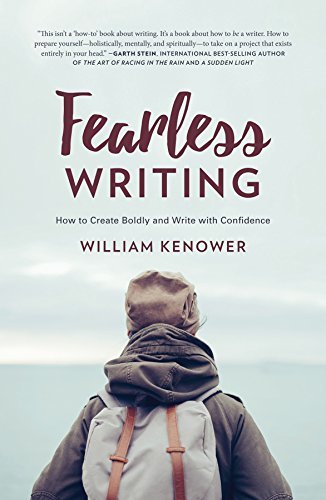
Book Review: Fearless Writing

book cover for Fearless WritingFind the courage to create your best writing life. Whether you're a fledgling writer or a veteran with years of experience, fearlessness—that elusive blend of self-acceptance, confidence, and curiosity—is the defining quality of those who find fulfillment and success. Truly fearless authors banish writer's blocks with ease, receive critiques gracefully, and infuse their passion for the craft into every word they write. Filled with insightful wisdom and practical advice, Fearless Writing teaches you how to thrive as a writer, no matter your genre or career path. You'll learn how to:
  • Find and enter a Flow state in which writing is a natural, deeply satisfying process.
  • Quiet both internal and external critics and embrace the inherent value in your work.
  • Use love, emotional engagement, and curiosity as the guiding principles for what you write and how you share it with others.
  • Overcome rejection, procrastination, and other obstacles that stifle your creativity.
From the blank page to the first draft, and from querying to marketing, the writing life is filled with challenges, roadblocks, and new experiences. With
Fearless Writing, you'll find the inner strength to embark on a bold journey—and build a lifelong career in the process.

I took a class based on this book a few years ago through Writers Digest University. It was handled remotely with assignments that went along with the lessons. The assignments were there to reinforce the lessons. And Mr. Kenower provided feedback on the assignments.

I loved it. It provided the spark I needed to finish my second novel, Gateway to Empire. I knew that I needed to have a copy with me on my desk at all times.

The book blurb does a great job outlining what's in this book, so I won't rehash it. I will point out that each chapter addresses some aspect of the writing or publishing process. Kenower always provides an anecdote that fits the chapter's subject which reinforces his overall argument. I'll admit that I wasn't necessarily 100% convinced by every chapter's example in and of itself, but Kenower was at least consistent with his argument, and it made the argument presented in the book as a whole more solid.

I found myself reading it this year because I'm back in that dark place that I was before. That shouldn't be interpreted as a condemnation of the effectiveness of this book. The problem is all mine. I've suffered from recurring bouts of low self-esteem and depression my entire life, and my experiences with publishing haven't helped in the least. In fact, they've contributed to a feedback loop that constantly inhibits my ability to sit down and write. "Why do I bother?" is a constant refrain in my head.

But in Fearless Writing, Kenower offers the right pep talk to break me out of that vicious cycle. And I'm good for a while, but something invariably comes along to mess me up. So I will be reading this book again and again until it becomes second nature. I don't know if I'll ever succeed in defeating my personal demons, but I know I won't if I don't try.

\_/
DED

Monday, March 5, 2018

First Milestone in a While

Murphy saying hello to a frogEvery winter for the last several years, I've made it my resolve to take advantage of being cooped up indoors and write. If you've paid any attention to me whatsoever, you know that I haven't been successful at all at seeing that resolution come to fruition. Sometimes the reasons are good: I have a freelance job editing or coding and I'm actually earning money. Sometimes the reasons aren't so good.

I'll confess here and now: I have seasonal affective disorder. I've had it at least as far back as my teens. It varies in intensity over spans of weeks and from one year to the next. Most years, it just wears on me, dragging on me like I'm pulling a sled full of firewood uphill in the snow. But occasionally, it pulls me down into a pit of despair. Over the last few years, I've had back-to-back bad winters and life came to a grinding halt. Fortunately, I have a loving wife and family to help me get through it.

I don't bring this up because I'm seeking pity. I don't like talking about it in general. When I grew up, admitting that you had a problem like this was a sign of weakness (I can only imagine what it's like for veterans with PTSD), and that hasn't left me, though society seems to be getting better about it. The reason why I'm bringing it up at all is that I feel like I owe an explanation to anyone and everyone who has paid any sort of attention to me as a writer. I feel like I've let them down. I want them to know that I'm not lazy or apathetic; I self-sabotage. I make up reasons not to write, or I'm such a zombie that before I know it, the day is gone. And this goes on every year.

But this winter I've managed to keep plugging away. I still throw up roadblocks to progress, but I've been able to make my way through the barricades more often than not. So I'm happy to announce that I've reached the 30,000-word milestone with the manuscript. To me, that could very well be halfway. Armistice Day wound up at 66,000 words over 250 pages, so there's that. For me, it's a psychological milestone, and I felt like sharing. It gives me a measure of hope that I'll actually keep my word about finishing the book this year.

\_/
DED

Wednesday, November 22, 2017

Finished That Writing Course

Cover for DVDAfter all of the home repairs and seasonal chores, I finally got around to finishing this DVD writing course that I started back in February. I have to say that it was fantastic. I'm talking 5 stars. Landon opened my eyes to the potential of the sentence. I was a long sentence skeptic, but Landon demonstrated that they can be done well and delivered eloquently. He fights the notion that style should be invisible as it drains writing of its joy and makes it a tiresome burden for many a student. He sees long sentences as instrumental in the development of a writer's style, the text lending shape to the writer's voice.

The guidebook that accompanies the DVD, while complete, lacks Landon's delivery and many examples that he presents in the lecture. It's like the "Cliff Notes" version of the lectures. Let me put it another way: The lectures have been boiled down, and this guidebook is the precipitate. While it covers the essential nuggets and provides what you need to know, it doesn't deliver the goods in the same way as Landon's lectures.

In the DVD, Landon's delivery clearly demonstrates his passion for literature. Not only is he lively, but he also punctuates his lectures with emphatic gesture and wit. At no point did I ever find myself bored, even when the material seemed too technical for my needs. The time spent viewing these lectures was well worth it. While I don't see myself trying to emulate Faulkner, following his lengthy written footsteps, I do feel that I can apply what I've learned to my writing. I highly recommend it for all aspiring authors.

Here's the link to their website. I bought it when it went on sale, so check back periodically if you're on a budget (like me).

\_/
DED

Tuesday, June 6, 2017

Book Review: The Dreaming Void

book cover for The Dreaming VoidTo read the book blurb, click here.

I don't give up on books; I always see them through to the end. I came close to quitting Rainbow's End, but I stuck with it. But not this time. 80 pages in and I'm done.

When I ran an indie book review blog, I had a simple system set in place. If the blurb piqued my interest, I'd read the first chapter to see if I was hooked. It was a good system, but not perfect. Some clunkers got through. Apparently, I need to apply that same system to traditionally published books. Blurbs (and Goodreads recommendation engines) aren't enough.

The opening sentence was a dud. The Prologue was dull. Every single bit of writer's advice that I've heard and read states that you have to hook your reader with the first sentence, the first paragraph at the very latest, but this doesn't do that. The first sentence:

The starship slipped down out of a night sky, its gray and scarlet hull illuminated by the pale iridescence of the massive ion storms that beset space for light-years in every direction.

Pretty, but not exactly hook worthy. The rest of the Prologue describes this guy's arrival at an scientific observation post and then his attendance at a party. When he's tired and had his fill of socializing, he goes to his quarters to sleep. And then he has "the dream." End of Prologue. I think "the dream" was meant to be the hook.

The book blurb says that said dream was of a paradise that lies within the spatial anomaly that the observation post has been studying for centuries. This is the fantasy setting that people have referred to in the Goodreads comments. Apparently the dreams spawned a religion and everyone wants to migrate there. But why? Magic? These people already benefit from FTL spaceships that reduce travel time to distant stars to mere hours and have all the body modification abilities that transhumanist wannabes could possibly desire. I found it lacking. Maybe transhumanists in the future are bored (spoiled?) with centuries long lifespans and want more.

There wasn't any action until page 57, and it came out of nowhere. Everything was character introduction and gee whiz fantastic tech. The character who participated in the action scene never revealed any indication in his previous scenes that he was anything more than a pilgrim just chillin' before the big trip. I had trouble forging any sort of connection with the characters. I felt lost and bored, struggling to read more than five pages at a time.

If I'm reading Hamilton's bibliography correctly, this was his 11th novel. His publisher must figure that he's got his audience. No need to mess with the formula; it works. No hooks necessary. The man is the hook.

Even though I didn't like the book to this point, I'm giving this at least two stars for world building, pretty prose, and—I'm going to make an assumption here—an intricate story. With the right audience, it works. However, I'm not that audience. And that's a pity. I'd read "Blessed by an Angel" and I was keen to explore the worlds he created. Now, not so much.

This review initially appeared on Goodreads.

\_/
DED

Tuesday, April 4, 2017

Started a New Writing Course

This was originally posted on my Launchpad blog on February 14th. I felt that it deserved to be resurrected from the abyss.

Two years ago, I purchased two courses (at discount) from the Great Courses, a site that sells collegiate level lecture series on DVD. No, you won’t get college credit, but you will learn something.

Sadly, they’ve sat on a shelf waiting for me since I purchased. Not exactly a rousing endorsement. I won’t bother you with my excuses why I haven’t watched them. None of them has anything to do with the products themselves.

Anyway, I finally started one of them today: “Building Great Sentences: Exploring the Writer’s Craft.” The course consists of 24 lectures taught by Professor Brooks Landon, Ph.D. of the University of Iowa. I bought it because I know there’s room for improvement in my creative writing, especially since I spent my college days writing lab reports and engineering feasibility studies.

After watching the first lecture, I have to say that Professor Landon seems like an excellent choice to teach the class. He definitely struck me as passionate about the craft of writing, even after 30+ years teaching the subject. He kept what could easily be a dry subject—sentence structure—interesting. There were even a few instances where I had a chuckle. Hopefully, it continues all the way through.

\_/
DED