Monday, July 27, 2026

Book Review: Ancillary Sword

book cover for Anciallry SwordBreq is a soldier who used to be a warship. Once a weapon of conquest controlling thousands of minds, now she only has a single body and serves the emperor she swore to destroy.

Given a new ship and a troublesome crew, Breq is ordered to the only place in the galaxy she will agree to go: Athoek station, to protect the family of a lieutenant she once knew – a lieutenant she murdered in cold blood.


So I read the first book, Ancillary Justice, nine years ago, which was four years after it came out. This book came out a year after the first, but I'm just getting to it now. Why? Well, Goodreads friends of mine had mixed feelings about it and warned it was even more soaked in tea than the first book. But also, by then I'd discovered Murderbot and that's been a far more enjoyable series. In fact, I was wondering if I should re-read Ancillary Justice to see if my opinion of it (five stars) held up.

Not wishing it to collect any more dust on my nightstand, I read it. I'm glad I did, but I didn't love it. Yes, everyone is having tea, and they're having it all the time. It's right there on the very first page.

So the Radch, the name of the empire, comes across as Victorian era Great Britain: The non-stop tea drinking, priceless tea sets, tea plantations, indentured servitude, self-righteous attitudes towards the "uncivilized heathens", fussiness about manners, and aristocratic nobility getting anything they want because of who they are. I didn't get that in the first book, but here it's in our face. With Breq being granted a ship and the rank of Fleet Admiral, we're thrust onto the high seas with Athoek Station as port-of-call. I'm picturing Victorian navy uniforms, all epaulets and big hats.

I found myself more annoyed by usage of the feminine pronouns than in the first book (The Radch doesn't acknowledge gender, so the default is "she") for two reasons. The first is that the indentured people on the planet do acknowledge gender so Breq is forced to be respectful and use their proper pronouns and titles like "grandfather." She struggles to get it right (Wait a second, did I?). The second is that in the Radch navy, everyone uses "sir" to address officers. So everyone is addressed by the feminine all the time in the Radch, except in the navy when they're also addressed by the masculine. The switching back and forth from she to sir and back again was silly. And with more characters to deal with, I had to look for behavioral clues to figure it out. Why was that important? Well, as a reader, I'm always trying to concoct a picture of the character in my head, and Leckie's not making that easy for me. I think I got it right. Maybe.

Anyway, back to the story. The galactic intrigue is put on the backburner. There's a murder that could've been something, but it wound up being nothing other than an excuse for Breq to go down to the planet to observe a mourning ritual. Once there, the whole story turned into the whole Victorian British Empire tea plantation indentured-servitude-is-bad thing, which is fine, but not what I tuned into this series to read about.

Again, it was a fine read, but not what I was hoping for. And with the meh reviews of the third book in the series from my Goodreads friends, I don't know if I want to bother continuing with this series. I mean, there are only so many tea parties I can read about, particularly since my daughter is too old to have them with her stuffed animals.

3 stars

\_/
DED

Monday, June 8, 2026

Book Review: The End of All Things

book cover for The End of All ThingsHumans expanded into space and found a universe populated with multiple alien species bent on their destruction. Thus was the Colonial Union formed, to help protect us from a hostile universe. The Colonial Union used the Earth and its excess population for colonists and soldiers. It was a good arrangement...for the Colonial Union. Then the Earth said: no more.

Now the Colonial Union is living on borrowed time—a couple of decades at most, before the ranks of the Colonial Defense Forces are depleted and the struggling human colonies are vulnerable to the alien species who have been waiting for the first sign of weakness, to drive humanity to ruin. And there's another problem: A group, lurking in the darkness of space, playing human and alien against each other—and against their own kind—for their own unknown reasons.

In this collapsing universe, CDF Lieutenant Harry Wilson and the Colonial Union diplomats he works with race against the clock to discover who is behind attacks on the Union and on alien races, to seek peace with a suspicious, angry Earth, and keep humanity’s union intact...or else risk oblivion, and extinction—and the end of all things.


In the previous entry of this series, The Human Division, the book was a collection of a serialized stories bundled together with an overarching storyline. It didn't work for some people, but it worked for me. This entry gets to the bottom of the matter: Who's trying to sabotage the Colonial Union? The story is told over four novellas which offer varying viewpoints as to what's going on in different places and at different levels of society in Scalzi's Old Man's War universe.

The opening story is "The Life of the Mind" in which we see where all of the missing ships went. It's told from the viewpoint of Rafe Daquin, a computer programmer turned starship pilot who's just looking for work. He signs up for third string pilot aboard the Chandler and gets more than he ever bargained for. The ship is captured and he's forced to pilot the ship for Equilibrium, the organization looking to make life hell for the Colonial Union (CU). But despite being at their mercy at the outset, he plots his revenge.

"This Hollow Union" gives us a look inside the political operations of the Enclave, a confederation of 400 species who are united in their opposition to the CU and still smarting from their comeuppance at the conclusion of The Last Colony (Book 3). It's told by Hafte Sorvalh, the de facto number two of the Enclave. The Enclave is torn over what to do about Earth. Readers of the series will know that Earth told the CU to bugger off after they learned what the CU's been doing, not to mention that they believe the CU destroyed their space station. Some want to admit the Earth into the Enclave; others hate this idea as you just can't trust Humans. There's plenty of intrigue, and I admit to being caught off guard by the big reveal at the end.

"Can Long Endure" embeds you with a team of CU Marines as they're sent from one assignment to the next. CU colonies are upset and threatening to declare their independence. The CU can not allow that, and so the Marines are sent in to remind these would-be rebels that that would be a bad idea. Lt. Heather Lee listens to her squad debate matters from the CU's troubles to what's being served for lunch in the mess hall all while trying to stay above the fray and making sure that they focus on the job at hand. It's fairly lighthearted until the last world they're sent to and then Lt. Lee has had enough.

"To Stand or Fall" picks up where "Can Long Endure" leaves off. Lt. Harry Wilson narrates this one after appearing in "This Hollow Union." He's a realist, recognizing that the CU is falling apart but also that it's humanity's best chance for survival. Thanks to some clever interrogations, he's able to figure out the Enclave's grand plan that will tear everyone apart. The hard part is figuring out how to prevent it.

It's trademark Scalzi at the top of his game. He has characters you can root for, wonderful dialogue, and a worldview that I can get behind. While all of the worldbuilding was done at the beginning of the series and the aliens are people in rubber suits, I didn't mind. It works. It's solid entertainment for this reader.

4.5 stars

\_/
DED

Monday, May 11, 2026

Book Review - Black Star Rising

book cover for Black Star RisingWhen a mysterious alien spacecraft approaches the Earth and demands to speak with the President of the United States, then destroys a large Pacific island to demonstrate its strength and its seriousness, you'd expect the President to talk. Problem is, in the late twenty-first century, there is no President—not even a United States. China rules the Americas, and to most people "US" and "USSR" are just quaint abbreviations in historical dictionaries. But the aliens prove unreasonable about accepting substitutes. So one Anglo rice-cultivator from the Heavenly Grain Collective farm near Biloxi, Mississippi is forced to begin an adventure that will take him from peasant to President, from Pettyman to Spaceman.

I remember when this book came out. I was subscribed to a science fiction book club (that might've even been the name), and this was the book of the month. I was intrigued by the cover and made a mental note to check it out in the future. Decades later, I found it at one of the used book sales I frequent and picked it up.

What a disappointment.

It's easy enough to picture this as an alternate future where the US vs. USSR nuclear war has happened and the economic reforms of Deng Xiaoping have never happened. It's a bit stale, but not far-fetched. The far-fetched stuff comes later, after we meet the aliens. But I won't spoil that for any would-be readers.

The story starts off as satire, devolves to farce, and then falls flat trying to deliver some sort of message at the end.

The characters exist to advance the plot. I couldn't really root for any of them. We start with Castor, a man in his early 20s who has stars in his eyes but is pretty thick-headed about women. I felt a little bad for him early on, but that soon faded. There's a Chinese police detective in her 40s named Delilah who becomes Castor's sexual partner. Her constant denial of her feeling is over-the-top. Professor Fung Bohsien, aka Manyface, who has had the brains of dying people added to his in order to save their minds. The end result is a bit like multiple personality disorder. There are some alien characters, but to divulge anything about them would be a spoiler.

Pohl infuses the story with sexism and that attitude about sex that is common for sci-fi writers in the post "free love" era of the late 60s to mid-80s. It's very male fantasy oriented as that's who the target demographic was: teenaged boys and horny old sci-fi writers men. As a teenager in the 80s, I didn't know any better, but later as an adult, I realized wasn't real at all.

The coolest part of this book is the cover and the title. I should've just stuck with that rather than read it.

1 star

\_/
DED

Wednesday, April 22, 2026

Book Review: Children of Ruin

book cover for Children of RuinLong ago, Earth's terraforming program sent ships out to build new homes for humanity among the stars and made an unexpected discovery: a planet with life. But the scientists were unaware that the alien ecosystem was more developed than the primitive life forms originally discovered.

Now, thousands of years later, the Portiids and their Humans have sent an exploration vessel following fragmentary radio signals. They discover a system in crisis, warring factions trying to recover from an apocalyptic catastrophe arising from what the early terraformers awoke all those years before.


The book runs with two alternating storylines: the "present" (which is a joint venture between Portiids and Humans two generations after the events in Children of Time) and the distant past, roughly equivalent to the start of Children of Time. Eventually, the older timeline is advanced until it catches up to the present.

In the old timeline, we're introduced to a group of terraformers who've arrived in a system that, surprisingly, has life in it. Rather than destroy it, the terraformers split up: Half will study the lifeforms of the world (Nod), while the the other half will terraform the next planet out from the host star. Unlike Avrana Kern's expedition in Children of Time, there is no suicide bomber on board. Still, the Luddite faction back on Earth still manages to find a way to derail this batch of terraformers. But that isn't the worst of it, for Nod has an insidious lifeform of its own that threatens to devour everyone it encounters. There's a scene with serious The Thing vibes that I found terrifying.

Meanwhile, the terraformers successfully establish an octopus civilization on the other planet. Tchaikovsky does a fantastic job detailing how a sentient octopus thinks, behaves, and communicates and how their society might function. World building has always been his strong suit, and his ability to get inside alien minds is among the best in sci-fi.

So when the Kern's World expedition arrives, all signs point to some kind of war in progress. A scout ship sent to make contact finds out the hard way what's actually happening. The Humans and Portiids are still trying to iron out the wrinkles in their interspecies communication (vibrations for the spiders, vocalized language for the humans) and now they find that octopuses primarily communicate via color.

The book is a bit of a slow burn, and sometimes it seemed like Tchaikovsky was retreading the same old ground and story points. There were long passages of summarizing, where centuries of the octopus civilization's progress was told in anthropological fashion. It wasn't bad—Tchaikovsky manages to keep it interesting—but it can be dry and pads the word count. I think this book could be 10% shorter. It was at the midway point that the story's pace really picked up. Since I didn't bail, that's proof enough that Tchaikovsky knows what he's doing.

4 stars

\_/
DED

Friday, April 17, 2026

Draft2Digital Adding Fees

Draft2Digital logo

If you're an author who uses Draft2Digital for publishing your work, then you already know what I'm about to post. For the rest of you, read on.

Draft2Digital sent out an email this week informing its clients that they're going to add user fees to their platform. The first is account activation fees. Due to "automated content farms" overwhelming them with "slop," (in other words, AI-written books) they're requiring a one-time $20 fee to set up an account. Combined with "verification tools and human reviewers," they hope to cut down on those clowns that are abusing the system.

I'm ok with this. Granted, I'm an existing account holder so I'm exempt from this fee. However, the next one hits me, and I'd imagine probably about 90% of the authors who use their service.

There will now be an annual maintenance fee of $12 applied to all "accounts whose earnings from book sales, meaning your net proceeds after D2D's commission, total less than $100 over the preceding 12-month period. If you earn $100 or more from your book sales over 12 months, you will not be charged this fee." (emphasis on "net" is mine)

So if your book sales suck, which admittedly is most of us indie authors, you're not pulling your weight. We apparently need to up our game because we're a drain on their margins. As if we're not dealing with enough production costs (editing, typesetting, cover art) and marketing costs (ad campaigns, giveaways, paid reviews, etc.), we now have the added pressure of meeting our digital printer's revenue quota or else pay an annual fee. Swell.

As Smashwords is a D2D property, expect to see their FREE section to dwindle to next to nothing (well, successful authors can introduce the first book in a series for free to lure readers in and hope they can hook them for the rest of the series). In the past, Smashwords published statistics showing that the vast majority (90+%) of books that were purchased from them were books listed for free.

Needless to say, I am unhappy about this. I typically list my books for $2.99. After D2D takes their cut, I get $1.78. So I need to sell 57 copies to avoid the additional $12. If you think that's easy, then you don't know how difficult indie publishing is.

\_/
DED

Saturday, March 7, 2026

Book Review: The Rosewater Insurrection

book cover for Rosewater InsurrectionAll is quiet in the city of Rosewater as it expands on the back of the gargantuan alien Wormwood. Those who know the truth of the invasion keep the secret.

The government agent Aminat, the lover of the retired sensitive Kaaro, is at the forefront of the cold, silent conflict. She must capture a woman who is the key to the survival of the human race. But Aminat is stymied by the machinations of the Mayor of Rosewater and the emergence of an old enemy of Wormwood...


Whereas the first story in this series is told from the perspective of Kaaro, xenosphere sensitive and S45 agent, he takes a back seat here while Thompson tells the tale of Rosewater Insurrection from multiple perspectives. There's Aminat, S45 agent and Kaaro's girlfriend; Alyssa, a woman who can't remember who she is or any of her family; Jack Jacques, the mayor of Rosewater; and Anthony, the avatar of the alien Wormwood that is the heart of Rosewood. There are also a handful of minor characters who help move the story along: Eric the assasin, Walter the author, and Bewon the disgruntled guy.

Thompson doesn't waste much time getting to the insurrection referenced in the title. The president of Nigeria insists that Rosewood have elections and already has a candidate in mind. He's intent on driving Jacques out of office, but the mayor resists and declares Rosewater's independence. This pisses off the president, who calls in the military to violently put down the insurrection. Jacques is counting on Wormwood to protect the city, but something's amiss.

Anthony intuitively knows that something is making Wormwood sick, so he seeks out the cause. Meanwhile, as the bombs fall and bullets fly, Aminat is trying to find Alyssa and bring her in for study as S45 thinks there's a connection between her and the alien.

In Rosewood, we only got to see Aminat through Kaaro's eyes, but she really comes into her own here. She has to walk a fine line between her love for Kaaro and following her boss's orders to bring in Alyssa, made all the more difficult by the battle raging in the city. Alyssa is treated to her own evolution from selfish amnesiac to something more. I admit it took me a while to appreciate her as a character. And we get the mayor's backstory too. Parts of it will certainly have some readers thinking TMI, but it does help explain how he became the man he is.

The Nigeria that Thompson describes in 2066 is as complicated as it is today. Thompson doesn't sugarcoat his descriptions of the place. Suburbs and modern technology are countered by poverty and criminal gangs. The line between politicians and crime lords is a thin one. "The Tired Ones," an organization that Mayor Jacques has been involved with for decades, offers a sober perspective revealing the continent's nations are still stuck in a kind of adolescence.

Thompson also offers us a look into the homeworld of Wormwood. While it seemed in Rosewater that the aliens might've been benevolent in their colonization of Earth, Insurrection reveals that the aliens aren't on a moral high ground compared to us humans. Like us, they're not a monolithic people. All you can do is hope that the good guys win. It might be difficult to determine that though.

4.25 stars

\_/
DED

Tuesday, February 3, 2026

Book Review: Sundiver

book cover for SundiverIn all the universe, no species has ever reached for the stars without the guidance of a patron—except perhaps mankind. Did some mysterious race begin the uplift of humanity aeons ago? And if so, why did they abandon us? Circling the sun, under the caverns of Mercury, Expedition Sundiver prepares for the most momentous voyage in our history. A journey into the boiling inferno of the sun... to seek our destiny in the cosmic order of life.

Brin's Uplift Saga was easily one of my favorite series way back in my younger days. The thing is, I started with the second book (Startide Rising), being unaware that the series started with Sundiver. I always meant to get to it, but didn't have a chance until now. Having done so, I'm going to re-read the six-book series which was published from 1980-1998.

So as the book blurb states, no species has ever reached the stars without the guidance of a patron. But somehow, Humans were able to do it on their own. It is an amazing feat, if true. However, it came with a few tradeoffs. On the negative side, we had to invent everything that the Galactic Library just teaches the other races, not to mention our species' tumultuous adolescence (wars, pollution, etc.). But on the positive side, we were spared the indentured servitude client races have to endure at the behest of their patrons. These can go on for hundreds of thousands to millions of years.

While a few races cheer us on, the vast majority see us as enigma or worse, an abomination. Surely, the Humans must've had a patron at one point but for some inexplicable reason, abandoned the uplift process, a crime by galactic standards.

Rumors are circulating that clues to our patron can be found inside the sun, so an expedition is underway to search for those clues. How can a spaceship possibly survive a trip into the sun? Well, there's a back-of-the-envelope style explanation that Brin gives us and it involves a refrigerator laser and thermodynamic equations that I don't fully understand, but he holds a doctorate in astrophysics, so I trust him that it's legit even if the technology is currently beyond us.

So besides the human crew and passengers, there are some alien representatives going along as advisors and witnesses, some friendly, some not. Jacob is our protagonist, who was invited to go along by Fagin, a Kanten (a mobile, tree-like species), to serve as an investigator. The story is primarily told from Jacob's viewpoint. Also present are the commander of the ship, Helene deSilva; Bubbacup, a Pila representative from the Galactic Library; his assistant Culla, a Pring, who are a client race to the Pila (pictured on the cover); Dr. Kepler, the Human head of the mission; Dr. Martine, a psychologist; and LaRoque, a politically charged journalist invited along to write about the mission.

Brin crafts the story as a mystery. There's a murder to go along with schemes to end the mission with disappointment or failure—depending on the schemer. It's up to Jacob and his fellows to figure things out to save Earth's reputation and (mild spoiler) their lives, for the stakes are higher than they realize.

All in all, an enjoyable read.

4 stars

\_/
DED

Tuesday, January 6, 2026

I Hate Marketing: Goodreads Giveaway

Goodreads old logo

At the end of August, I announced that I was running an eBook (Kindle) giveaway on Goodreads during the month of September. They were running a special (only $99!) whereupon I could give away up to 100 eBook copies, and they would handle everything: picking winners from those who signed up on Goodreads and sending out copies. I recently had acquired a debit card for switching ISPs, so I decided to go for it.

I chose Armistice Day for the giveaway in hopes that if people liked it that they would go on to buy Gateway to Empire.

I was a bit nervous come launch day. What if no one signed up for my book? I've never had a problem giving away things for free. I've given away couches, stairs, books, tapes, toys, 3D printed models, a door, and many more things, but still I worried that somehow either the book cover or the blurb would turn potential readers off.

Silly me. Never underestimate the power of free.

I had 75 people interested by lunchtime, and 120 people signed up by the time I went to bed. What a relief! Over the course of the month, the pace of signups slowed, but by the end of the month I reached 953 entrants! I was psyched!

Now most people don't go through the trouble to write reviews, so I figured that if I got five reviews, it would be a success. So I sat back and waited.

Three months later, I'm here to tell you what the results are.

Ok, there's no way to sugarcoat this. Things didn't pan out the way I'd hoped: I only got 1 review and 3 ratings. The review was good, and the reviewer gave me four stars. The other two ratings were three stars, which I'm completely fine with. And no, it hasn't led to more sales for Gateway to Empire.

The most recent rating came on November 15th, so what happened to the other 97 winners? Shouldn't I have received a bunch of ratings by now? Based on my GR experience, most people at least rate a book even if they don't review it. GR always wants to know what you thought of a book (so that it can recommend other books to buy read). It'll leave you alone if you rate the book. It won't nag you to review it. So my guess is that the bulk of the winners are voracious readers who enter giveaways because their appetite exceeds their wallet. They collect as many books as they can for free. They'll read them all eventually. Or not.

Just to clear, I don't blame GR at all. They handled everything professionally, didn't treat me any different than trad pub authors, and provided me with the statistics I requested.

Am I bummed about the poor review/rating to books given away ratio? You bet! But that's the way it goes. Would I do it again? Maybe, but not until I've had a chance to explore other methods first.

\_/
DED

Saturday, December 20, 2025

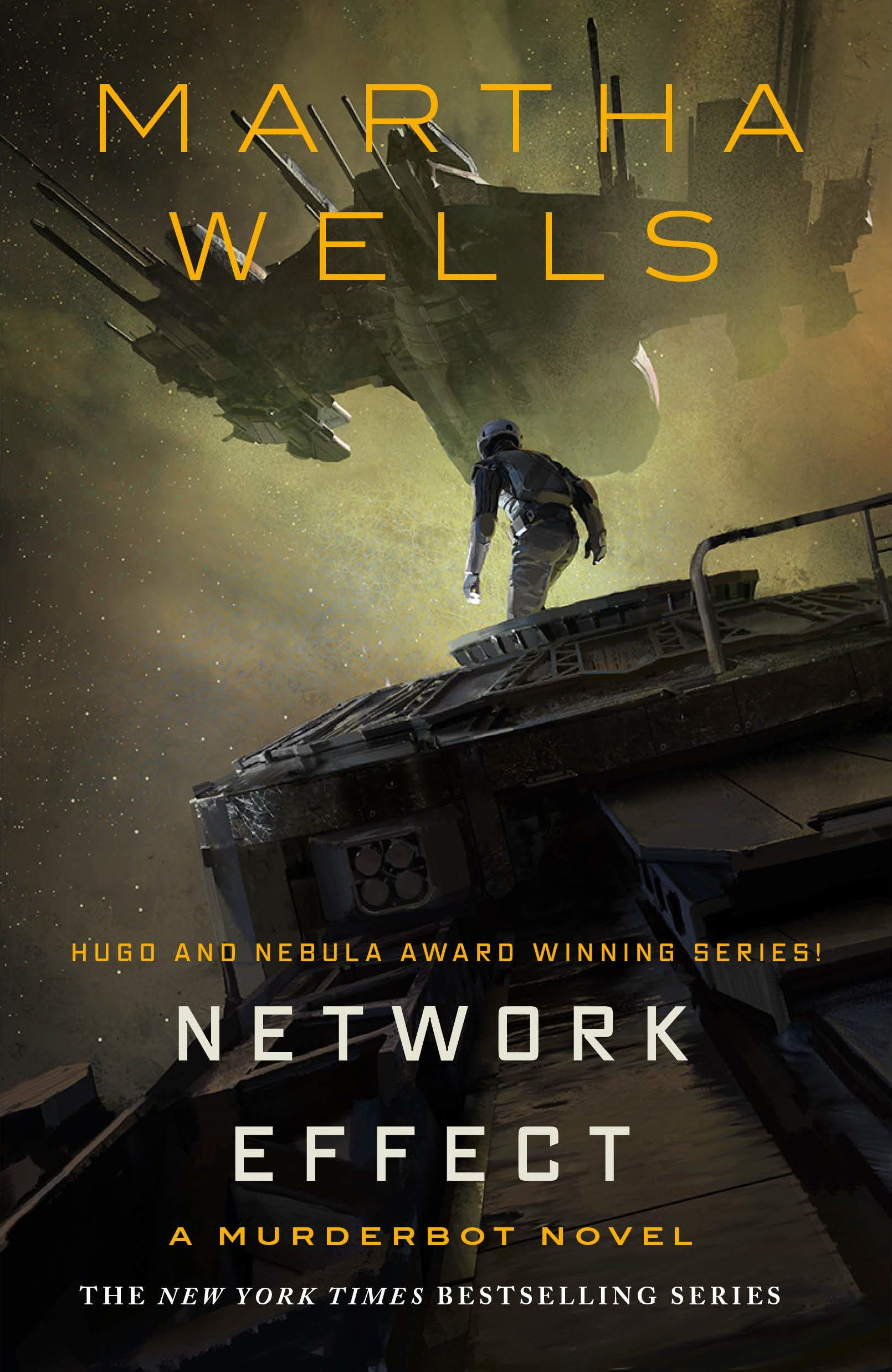
Book Review: Network Effect

book cover for Network EffectAfter reading a couple of short stories in this series, including one that's an intro to the humans in ART/Perihelion's crew (see Artificial Condition), I felt that I was ready to start catching up on Murderbot stories. Yes, it was good to get back.
The story opens up with Murderbot providing security for a research trip at the request of Dr. Mensah. Besides some friends of Murderbot's, there's also some of Dr. Mensah's family members on the mission. Not everyone appreciates Murderbot's expertise—it is a SecUnit after all—but you know they will eventually.

Oh and some thugs try to rob the expedition and hint at possible kidnapping.
Nobody fucking listens to me.
After that "welcome back" scene, there are some flashbacks and then the story soon moves into the main plot: On their way home from the mission, they're ambushed by a much larger ship and, despite Murderbot's efforts, are captured. Before they can be rescued, the captor ship escapes through a wormhole.

From here, Murderbot has to fight off the attackers, figure out who they are, and where they came from. ART shows up (it's more complicated than just showing up but explaining it would be a spoiler) and needs to have its crew rescued from the same raiders that attacked Murderbot's humans. The situation gets messy, and Murderbot is overwhelmed. That leads to an unlikely alliance of rescuers.

Feelings—Murderbot's dreaded f-word—make their way into the story, forcing Murderbot to have to confront them, which often leads to a system reset. But sometimes it's better at dealing with some feelings than others. For instance, there's another SecUnit in the story, just hanging around waiting to die (its clients are prisoners of the raiders). Murderbot recognizes the predicament this other SecUnit is in, so it makes it an offer: "I can disable your governor module. I'll do that whether you help me or not." Translation: I'll break the chains that bind you, that enslave you, that can kill you, and you don't owe me a thing. It's such a wonderful act of selfless compassion from a snarky person who claims not to care about others, except when it so obviously does.

4.5 stars

\_/
DED

Sunday, November 16, 2025

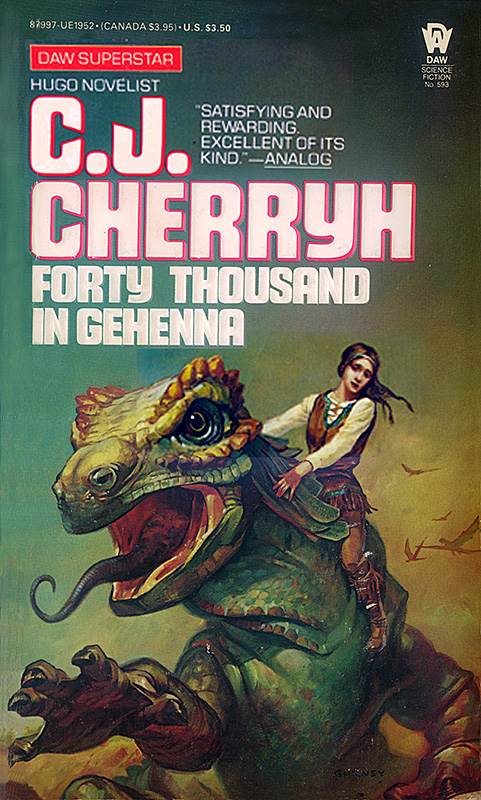
Book Review: 40,000 in Gehenna

book cover for 40,000 in GehennaFound this at the annual C.H. Booth Library book sale. It's a standalone in the Alliance-Union Universe of which Downbelow Station is probably the most well-known. Having recently read The Pride of Chanur, I was curious to read something else by C.J. Cherryh. Unfortunately, this one wasn't as enjoyable.

The book is essentially divided into three parts: the founding of the colony by the Union and its demise, re-contact with the descendants of the survivors by the Alliance, and the rise of the Gehennan civilization. The first section starts out dull and then fades into a depressing morass of doom. The middle section is ok, but every time an interesting character comes onto the scene, their time on the stage is too short. The last section proves to be the best as not only do the characters stick around, but we get to learn about how humans and calibans have interacted to build their civilization together.

I think this book would've been better if Cherryh eliminated that first section altogether and just summed it up in a briefing of Alliance sociologists or had them figure things out as a mystery.

The majority of the colonists were azi, programmable clones. The azi got their skills uploaded into them via "tapes." While they didn't have a choice as to whether they would go to Gehenna or not, they were promised that they could live like "born men" and have children of their own. While it was a promise that was kept, eking out a life on Gehenna proved difficult as the climate was tough on both man and machine and the supply ships never came.

The first section of the book spent a great deal of time on them, even looked into the life of one of them, Jin. When the clones have children, they lack their parents' reverence and obedience. You could say that they're rebellious, or that, being smarter than their parents, they realize that they've been screwed over.

But that final section is where Cherryh really shines. The dynamics of the human-caliban relationship is brought to fore. It's a complex one as human leaders interact differently with the calibans than the weirds do. While it might seem like a caste society, genetics are the true determination. The "first" among a tower will quite likely have a child that shows the characteristics of a weird. The calibans have their own battles for dominance based on color and size. And calibans play a large role in human politics.

But getting to this last part required a lot of patience from me. While some readers have plenty of patience, other potential readers might not. If you're the type of person that can hold out for 100+ pages, you have a chance. If you're not, well...

Two-star start. Three-star middle. Four-star finish. So, three stars overall.

\_/
DED

Tuesday, October 14, 2025

Book Review: Rosewater

book cover for RosewaterRosewater is a town on the edge. A community formed around the edges of a mysterious alien biodome, its residents comprise the hopeful, the hungry and the helpless—people eager for a glimpse inside the dome or a taste of its rumored healing powers.

Kaaro is a government agent with a criminal past. He has seen inside the biodome, and doesn't care to again—but when something begins killing off others like himself, Kaaro must defy his masters to search for an answer, facing his dark history and coming to a realization about a horrifying future.


Rosewater offers a fresh perspective on the alien contact sub-genre. It takes place in Nigeria with a cast of characters who are locals. America has gone dark, and no one knows why. The remaining world powers keep their distance, though at least one would like to learn more about the alien biodome. But they're on the periphery at best. Instead, it's the Nigerian government that has a vested interest in this strange visitor that appears to be both benevolent and threatening.

The story is completely told from Kaaro's POV. He's a sensitive, someone who can read minds thanks to the xenosphere, an effect created by microbes and spores emanating from the biodome. There are a couple of timelines that the narrative switches back and forth from, and one of them involves Kaaro's youth when he stumbled upon his abilities. It turned him into a thief. We learn how he honed his abilities, his recruitment into a government spy agency (S45), and his day job in xeno-security where he defends a bank from criminals who use their sensitivity to hack bank accounts.

I usually don't enjoy stories involving any super-mental capabilities (telepathy, telekinesis, teleportation, etc.), but the way Thompson establishes how sensitives work with the xenosphere, the limitations placed on it, and countermeasures, it was something that I could get behind.

Kaaro is not without his flaws. In the oldest timeline, we endure his thieving. During the recruitment process, he's a coward and a womanizer. In the "current" timeline, he's a jaded, dour man in his 40s. We root for the younger Kaaro to grow up and the older Kaaro to stop being so cynical. Thompson does a great job with Kaaro's evolution, though I wanted one timeline to resolve itself before going to the next. But the way Thompson has the story structured, waiting for the big reveals turns out to be the best move.

I look forward to reading the rest of the series.

4 stars

\_/
DED

Thursday, September 11, 2025

Book Review: Brothers

book cover for Brothers by Alex Van HalenI wasn't planning on reading this book. While I enjoyed the first few Van Halen albums—I checked out after 1984—there are a lot more people further up on the fan spectrum than me. But a friend of mine loaned it to me, thinking that I might enjoy reading it (I'd loaned him Bruce Dickinson's What Does This Button Do?, so fair exchange). And yes, to some extent, I did enjoy reading it.

Alex takes a semi-chronological approach: how his parents met, the early years in Amsterdam, moving to America, and growing up in Pasadena with Ed. Music was a large part of the Van Halen brothers' lives growing up as their father played in jazz bands from before they were born. Another large part of their lives was alcohol, and they started young. Different times.

Alex goes to talk about the early formative years of the band, revealing the gradual evolution of what would become Van Halen. Fun Fact: David Lee Roth was the one who suggested they call themselves that. He thought their name sounded "strong" and had "power to it." Alex talks about each album, a little bit about recording, some more about touring and what it's like (for him) to be a musician. But the book pretty much ends with Roth's departure from the band.

Michael Anthony and Sammy Hagar are background figures. How the former wound up joining the band is there and the latter is suggested by Ted Templeman (producer) as a replacement for Roth when they went into the studio to record their first album. But that's it. And Gary Cherone doesn't even rate a mention. There are a few people that get discussed (particularly if they wrote a book or conducted an interview with a band member), but it's primarily Roth that gets the focus. Alex berates him in one paragraph and praises him in the next. It sounds sometimes like Roth was the third brother.

Alex pulls in a lot of quotes from other people. He admits this at the end of the book. He felt that they helped to jog his memory (He was 70 when he wrote this). After pulling the quote Alex responds to it. Sometimes it comes across as argumentative, but to be fair, he's just giving his side of things and he does give credit where its due.

I'd recommend this for Van Halen fans who want to know a bit more about the brothers' formative years, the first half dozen albums, and Alex's perspective on life with Ed, music, and the entertainment industry. People forget just how great a drummer he is, having been overshadowed by Ed. But he doesn't brag or begrudge Ed. You can tell how much he loved Ed, how much he loved playing music with him, and how much he misses him. While it would've been great to hear how certain songs came together, but it's like the old saying, "Writing about music is like dancing about architecture." You pretty much had to be there.

3 1/2 stars

\_/
DED

Sunday, August 31, 2025

I Hate Marketing - Getting Reviews

man holding sign that says please review my book
I hate marketing; I really do. But I know that "publish it and they will come" is not an effective strategy. I've tried it; many many indie authors have tried it.

So we try to get some reviews. Maybe we ask a friend or they just do it without asking because they realize how difficult it is to get reviews. But that quickly dries up, so we move on.

We submit our ebooks and physical copies—only if necessary—to those few review sites willing to actually read and review indie published books. There aren't many, and so for every book they review they have to say no to a hundred more. I know this firsthand as that's what we had to do here when we were open to submissions—something I hope to do again someday. And after a couple of years, well, you get burned out, or there just isn't time as real life gets in the way. Something has to give, and writing free book reviews is an easy choice to get the ax.

Now some entrepreneurial types figured out how to keep writing book reviews for indie authors. You could pay someone to give you a five-star review on Amazon. Maybe they had a few sock puppets to give you several five-star reviews. Some people did it themselves. Once it got out of control and reviews on Amazon didn't mean shit, Amazon cracked down and only allowed verified purchasers to write reviews. Does it still go on? Maybe. I don't know. But it gave paid reviews a stigma. How would you know if the review was honest?

Well, some people figured out how to do it the right way. I think it might be the norm now. I recently went through the list of reviewers at the Indie View, and there were a lot of paid review sites. But I wasn't ready for that yet.

But the free indie reviews list for sci-fi was short. There were plenty that were MIA or closed to submissions. I did manage to come up with a list of several sites and submitted my requests. That was July. Only one person has replied to say that they're interested. One site auto-replied to tell me to watch their site. Maybe they'd review it; maybe they wouldn't. The rest of them didn't respond at all. I'm not surprised by it really, nor can I blame them. They're probably inundated with requests and don't have the time to reply to them all. I get that. Sometimes people can be rude when you reject their book review request.

I realize that I'm going to have to open my wallet. I've got a debit card for switching my ISP and commiting to an extended period of time. It's found money. But I have to be smart with how I'm going to spend it on marketing. A few indie authors have shared how fast that ad dollar disappears. So I'm going with the biggest bang for the buck. Goodreads (owned by Amazon) is having a giveaway sale. I can give away 100 ebook (Kindle) copies to GR readers (that know to look for giveaways) for $99. The impression I get is that if I get five reviews out of that, it's a success. It runs for the month of September, so I'll report back to let you know how I did.

Want to read Armistice Day? Visit this page during the month of September to enter for a chance to win.

\_/
DED

Wednesday, August 20, 2025

Book Review: Swords Against Wizardry

book cover for Swords Against WizardryThis is the fourth book in the series and it contains four stories.

The first story is "In the Witch's Tent," and while it has some humorous aspects, it really just serves as a preamble to the next story.

And that story is "Stardock." Fafhrd and the Gray Mouser embark on an expedition to climb one of the highest mountain ranges in the world in search of a fabled treasure. It is said that the mountain range is so high that the gods used to dwell there and launched the stars into the night sky from the tallest peak. The gods used gems as models for the stars and then tossed them aside when they were finished.

This expedition is Fafhrd's idea, him being accustomed to cold laden lands and climbing icy peaks. Mouser is skeptical, but agrees to go anyway. Joining them is Hrissa the snow cat, who helps with the hunting and the fighting.

The journey makes up a good deal of the story. Leiber goes into so much detail describing climbing up the cliffs, dealing with the cold, and traversing the frozen wastes that I couldn't help but feel that he had firsthand knowledge mountain climbing, but I have no idea if he truly did.

The altitude, cold, and dwindling provisions lead Mouser to hallucinations which he dares not share with Fafhrd. But as they persist, he can't help but feel that they're real.

The third story is "The Two Best Thieves in Lankhmar." Our heroic pair have set out to sell their most recent haul, but each decides to outdo the other by selling their respective share to a jeweler or fence that each feels will give him the best price.

Women in the Fafhrd & Gray Mouser stories to this point are typically of the mother, maiden, crone variety, with maiden being the most common. But in this story, Leiber breaks out of the pattern that he's set and gives us female characters who can stand on their own.

The last story is "The Lords of Quarmall," a novella. Our heroes have had a bit of a spat and set off on their own for a while. Unbeknownst to them, each has been recruited by one of the sons of the Lord of Quarmall to serve as his champion. Both sons are adept sorcerors who despise one another. There's something of a "cold war" going on between them. Each has about a dozen sorcerors who cast spells attacking the other or defending their liege. Neither one is worth rooting for, and each of our heroes grows disillusioned with the job they've taken on. That leads to a bit of mischief. Ultimately, the cold war turns hot.

Besides the obvious familial intrigue, Lieber's Quarmall is a place where dread lurks in dark corners and forgotten rooms. The enslaved are not much more than zombies, forced to spend their lives (eternity perhaps) serving their master's needs, shambling on treadmills that turn fans that keep the air circulating in the forboding depths.

A solid collection of tales in the Fafhrd & Gray Mouser annals.

4.25 stars

\_/
DED

Saturday, July 19, 2025

Book Review: Footfall

book cover for FootfallThis is another entry in the alien invasion genre, one of the longest running plots in science fiction. War of the Worlds, probably the most well known work in this category, first appeared in print in 1897 (the novel in 1898). Hollywood spawned too many alien invasion movies to count in the 1950s and 60s. After a bit of a break—disaster movies and sci-fi adventures dominated the 70s—the sub-genre diversified. Some aliens were just stopping by to say "Hi" (Close Encounters of the Third Kind, E.T., Starman), while some were here to eat us (numerous horror movies). Footfall stuck to the invasion part, but mixed things up a bit.

Footfall was published in 1985, takes place in 1995, but feels like 1975. How do I mean that? Culturally. It's a vibe I get. Men are men, and women need men. Everyone is either getting laid or deciding if they should get so-and-so in the sack. It doesn't matter that the aliens are bombing the place; people are sizing up members of the opposite sex for their nookie potential. And in a scene both funny and cringey, the aliens, while raiding Earth, raid a movie rental store and grab some porn. The aliens watch the porn and are confused by it, demanding their human prisoners to explain it to them. Not that the aliens were prudes, they were just as obsessed with their mating season as the humans with their... well, I guess we don't have a "season."

It also feels like it was written for the big screen or maybe a TV series. It has a huge cast full of stereotypes with no real character development. There's a bit of bloat to it with dialogue that one might expect in a screenplay, particularly near the end with endless comm chatter. With proper editing this probably could've been 100 pages shorter. Definite popcorn material.

I initially read this in the 80s as a teenager. I liked it then, but I don't like it as much now. The aliens were cool, even if they were just baby elephants with bifurcated trunks. There was a concerted effort into developing their culture. They weren't an all-knowing sophisticated race—they seem to have stumbled upon the technology that enabled them to cross the interstellar void. Their dealings with humans left them stressed. Some of their soldiers seemed to be getting PTSD. Their confusion over how humans behave showed that they really didn't do their homework. If the whole story had been them trying to figure out humans and how to conquer them, it would've made for a more enjoyable story.

3.5 stars

\_/
DED

Wednesday, July 9, 2025

More eBook Formats for Gateway to Empire

book cover for Gateway to Empire

Well, it took far longer than expected, but Gateway to Empire is now available in other ebook formats besides Kindle. If you want it on the Nook, click here. For all other ebook formats, head over to Books2Read.com and choose your preferred platform. But if print is still your thing, well, there's that too.

And when you're done, a rating or a review would be greatly appreciated.

Thanks!
\_/
DED

Wednesday, June 18, 2025

Book Review: The Pride of Chanur

book cover for The Pride of ChanurWhen Tully, a fugitive from a spaceship captured by the arrogant, thieving, rodent-like Kif, takes refuge on the Pride of Chanur, a merchant vessel belonging to a clan of the lion-like Hani, Pyanfar Chanur, its captain, gives him shelter, in spite of all the dangers she and her crew will face.

I remember seeing this offered in the science-fiction book club that I was subscribed to in the 80s. For some reason— probably financial as high school me didn't have much money—I never picked it up. So when a local used bookstore went out of business and was selling off their inventory, I snatched it (along with several other books). I wish I hadn't waited so long.

The story is told from the viewpoint of Pyanfur, and I think it's a great idea. Humans are the alien here. When Tully shows up on her ship, she initially mistakes him for an intruder and thus her claws are out. She has no idea if he's a wild animal or not. When he starts writing something in his own blood, it dawns on her and her crew that this naked creature is a sentient being, alone and afraid. Some protective instinct is triggered inside of her, and she orders that he be treated for his wounds. It's a decision that she constantly wrestles with, for it puts her and her crew in danger. The Kif consider Tully to be their property and demand that she return "it" to them. She's no bleeding heart, but it strikes Pyanfur as wrong, and she strives to prove that Tully is sentient and deserves the rights that all sentients of the Compact—a trade agreement among several civilizations—enjoy.

Pyanfar knows that she needs allies. The way home is a long one, and the Kif have faster ships than hers. She's also outnumbered; the Hani are a feudal society and thus not all clans are willing to set aside rivalries when the threat is from another species. Pyanfar has to negotiate with other species, convince some of them not only of Tully's sentience but value as a potential trading partner once proper contact with his homeworld is established.

Communication is as much an obstacle as the Kif gauntlet. Even though Tully is an avid pupil—he realizes that he can't plead his case if no one understands him—it takes some time before he can communicate with the Hani. And even then, there's difficulty. But even among the established species of the Compact, communication is difficult. Different larynx shapes make speaking awkward. Short sentences dominate conversations. There's a lot of repetition. While there are machines to help with the process, Star Trek's universal translator does not exist. Still, when there's money to be made, people try to find a way to communicate.

I really enjoyed this story. I would've liked more world-building, but the way the story unfolds, there's really no time to dwell on that. It's very much a novel where everyone is living in the moment, trying to survive. While I appreciate shining a spotlight on the difficulty of interspecies communication, sometimes it was a bit cumbersome to read, not to mention repetitive when Pyanfar needed to get a point across. But those are just quibbles. It's definitely a classic sci-fi novel worth checking out.

4 stars

\_/
DED

Wednesday, May 14, 2025

Problems with Draft2Digital

I had every intention to get Gateway To Empire published in other ebook formats besides the Kindle, but those plans have gone awry. Previously, I used Smashwords to publish all of these myriad other ebook formats, but they were purchased by Draft2Digital (D2D). I discovered that they use a different formatting program than Smashwords.

I attempted to get this done in February, but I struggled to get the D2D software to properly format my manuscript. After weeks of frustration, I decided to take a break. Days turned to weeks turned to months. My attempts this month to try again have met with failure.

In the help section FAQ, here's what I found:

If I format my file myself, will it look exactly the same when you convert it?
No. Ebooks are a reflowable format that allows the reader a lot of flexibility in how they consume content. Draft2Digital's automated conversion process will strip out things that force formatting to be one exact way—embedded fonts, extra line breaks, empty pages, footnotes, or anything the system considers unnecessary to the final file.

I'm not trying to do anything fancy. I just want to get paragraphs to align, a particular quote to be indented, and the information pages (ISBN page, Other books by..., etc.) to line up. So I'm at a loss. I guess I'll keep pounding my head against the D2D wall.

The thing is: I really wanted to get all of the ebook formats set up so that when I contact indie book reviewers I can offer them copies in any format they might want. But now, I can't.

If anyone has any suggestions for alternatives to D2D, please let me know in the comments.

\_/
DED

Monday, April 21, 2025

Book Review: Leviathan Falls

Book cover for Leviathan FallsAn excellent finish.

This is the third book in the final trilogy of trilogies, the last book in the series.

At the beginning of this book Duarte remembers how to remember and is inspired. His protomolecule infused brain is certain that he now knows how humanity can defeat the protomolecule builder killers (PBK). Once he goes missing, Admiral Trejo authorizes Colonel Tanaka (whom we met in Persepolis Rising) to find him at all costs and by any means necessary. A task she takes to with reckless abandon.

Tanaka seemed like a reasonable person back in Persepolis Rising before she was relieved of duty for not being ruthless enough towards the inhabitants of Medina Station. But here, we learn how damaged she is and how ruthless she can be when trying to accomplish her mission.

Meanwhile, the Rocinante crew are busy with managing the underground and trying to find a safe place for Teresa to further her education and hide. And Dr. Elvi Okoye is desperately trying to figure out who the protomolecule builders were and how they perished before the PBK can figure out how to end humanity.

One theme running through the book is the strength of long term relationships. Elvi is running herself ragged and pushing herself, primarily coaxed onward by her all too willing test subject, Cara, to keep going. Her husband, Fayez, is her rock. He's always there, willing to be a sounding board and constantly reminding her that she's a good person. Naomi and Jim are extremely grateful to be back together after Holden's imprisonment. He stands back to watch her run the resistance even though he's been a figurehead for it for decades. Plenty of people view him as the one to watch, but he's the idealist while Naomi is the pragmatist, and the one actually calling the shots. Each loves, respects, and accepts the other for what they are, even if by being true to themselves, it leads to trouble.

Alex and Amos are still with us. Alex has to send stealth messages to his son because of who he is, and he really wants to see him and his grandson. Maybe someday, but he has a responsibility to the family he joined decades ago. Amos carries on in his perpetual even keel state, moreso since the events in Tiamat's Wrath. Teresa still treats him like an uncle and becomes his apprentice as ship's mechanic despite all that happened. She's tired of her old life and desperately hopes for her father to return to his senses. Amos is the one person whom she can count on to treat her as a regular person, not as a princess, heir to the Laconian Empire. And she loves him for it.

There isn't a lot of action here, so it seemed a little slow. The experiments that Elvi runs provide for more cerebral entertainment. There are two action encounters, both involving Tanaka, yet they're enough in their own right as each is bloody and vicious.

About 3/4 of the way in, everything comes together for the final showdown. While it isn't the epic battle of Tiamat's Wrath—the spaceship battles are in the background—the focus is where it needs to be. The challenge is the confrontation with Duarte and the PBK. The resolution makes sense to me. How can humanity deal with a megalomaniac, who's tapped into the power of the protomolecule, and with the PBK, an enemy capable of breaking molecular bonds and voiding everything out of existence?

4.5 stars

\_/
DED

Sunday, February 23, 2025

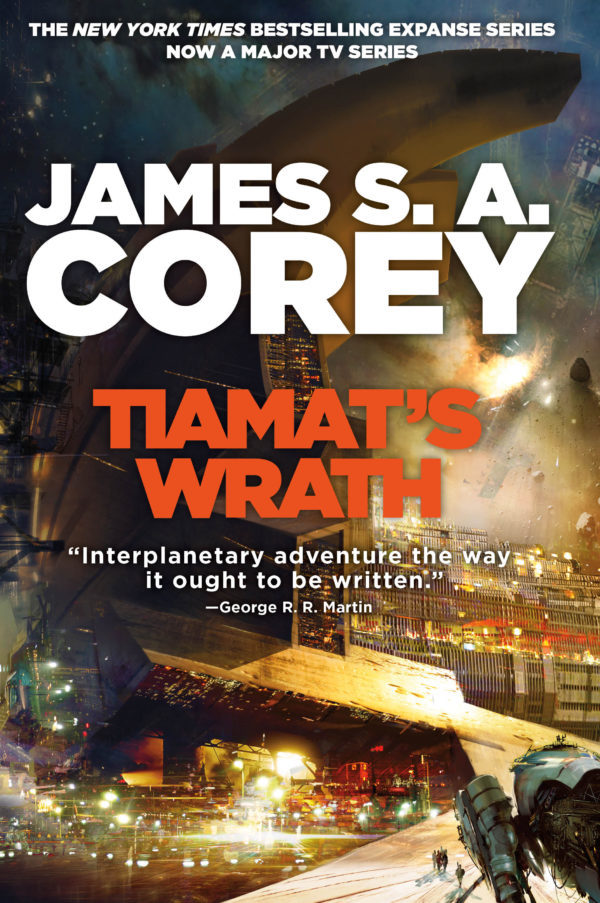
Book Review: Tiamat's Wrath

book cover for Tiamat's WrathWow, that was something!

This is book two in the third and final trilogy of trilogies that compose this series. And it might be difficult to top this one.

The book opens with Avasarala's funeral on Laconia of all places. Holden is still there and gets to talk to a few people—those willing to be seen talking to Duarte's "dancing bear"—about her and how much she'd hate it, which was probably Emperor Duarte's intent.

Except for the Epilogue, the rest of the book is told from the viewpoints of Bobbi, Alex, Naomi, Dr. Elvi Okoye (from Cibola Burn), and Teresa Duarte—yes, the Emperor's daughter. I'll start with her. Teresa is on a slow burn of teenage rebellion. She's growing disillusioned with people, whether they're her classmates or her adult handlers treating her with kid gloves. She loves her father, who is grooming her to be his replacement should anything ever happen to him. She finds solace with her dog and some hermit named Timothy who lives in a cave, calls her "Tiny," and says that she's the angriest person he's ever known.

Elvi has been drafted into the Laconian Navy and goes on exploration missions to the weirdest systems encountered in the gate network. Along the way, she's tasked with gathering as much information about the aliens that killed the protomolecule builders. Duarte has a plan for how to deal with them and has apparently never heard the adage to never poke the bear. He pokes it, of course, and boy oh boy does it get pissed off, hence the book's title.

Meanwhile, Bobbi and Naomi are at odds as to the resistance's strategy. Bobbi wants guerrila warfare and Naomi, who has sneaking around in shipping containers, prefers infiltration (putting their people in key positions) while Alex is caught in the middle. They're still family, but the way each deals with feeling powerless and seemingly hopeless odds, couldn't be any more different. Eventually, one of Bobbi's raids pays off, giving them a weapon they can use to strike back. But the price is so high.

If you've made it this far in the series and love these characters, you shouldn't be disappointed (but 6% are). There are a couple epic battles wherein our heroes depend on cunning to outwit the Laconians. The inside look at the Laconian inner circle from both Teresa's and Elvi's perspectives hammers home just how messed up cults of personality can be, not just the figurehead but the officers whose job it is to carry out the vision.

5 stars

\_/
DED