Wednesday, September 16, 2020

Book Review - Hideous Absinthe

book cover for Hideous AbsintheAdams has crafted a thoroughly researched tome that explores the history of absinthe use in society with emphasis on its peak use in the late nineteenth century. While it runs from ancient Egypt's medicinal uses up to today's connoisseurs on the web, the focus of the book is on its peak usage period from mid-19th century Europe to its eventual banning in the early 20th century.

I'd heard about absinthe some thirty years ago, and its purported mind-altering effects were the stuff of urban legend. When something is banned, all people have to go by are tall tales meant to keep a firm grip on the listener's attention. Adams explores that aspect. How much of absinthe's legend is true; how much is hype? He focuses on the poets and painters who were associated with absinthe. He goes into great detail about the lives of famous artists (Van Gogh, Gaugin, Verlaine, Degas, Dowson, Wilde, etc.) to determine how much of their work's success, moral shortcomings, and health failures can be attributed to "the green fairy." In fact, he goes into so much detail that I feel he got sidetracked. The book becomes less about absinthe and more a study of the Decadent Movement and its propensity for creating alcoholics.

After absinthe becomes a victim of its own hype, the narrative rushes to modern day. Contemporary accounts note that absinthe tastes like crap, and Adams barely questions why that may be. A few scientific accounts are brought up, but it seems that biochemical analysis was a bit lacking at the time of publication. We know that thujone is the active ingredient in wormwood oil that gives absinthe its claim to mind-altering fame, but there doesn't seem to be any consensus on anything other than toxicity levels. As for why its taste doesn't hold up? We're met with a shrug, which isn't a great way to end a book.

3.5 stars

\_/
DED

Wednesday, September 9, 2020

Book Review - Kaufman's Field Guide to Insects of North America

book cover for Kaufman's Field Guide to Insects of North AmericaWhen my son was little, he developed a curiosity about bugs. He'd ask me what a particular one was, but most of the time I didn't know. We'd then try to look them up on the internet (BugGuide.net is a good source). So one Christmas, his mom got us this book.
It's a great introduction to the world of insects (and select arthropods often misidentified as "bugs"). It's broken down by class and order with color photos and relative sizes of select species that are either common or of notable interest. After a general introduction about the particular group on a page, there's often another paragraph about a sub-group followed by a sentence or two about featured species or genera, typically the pictured individuals.

And so this has fueled our continuous drive to identify every insect we observe in our yard.

Who's that butterfly that keeps landing on Alex? Red Admiral

Do I need to worry about this beetle? No, it only eats decaying wood.

Is this bee going to sting me? No, it's just a yellowjacket that smelled the sugar in your drink. Don't kill it because it eats the bugs that eat our crops.

These ladybugs have different spots. That's because they're different species.

Dragonflies, damselflies, katydids, fireflies, soldier beetles, paper wasps, weevils, stink bugs, owlet moths, robber flies, ants, butterflies, and bumble bees. On and on.

One of the most useful features of the book is learning who's a pest and who's an ally. The pest identification part is obviously important, but even more so the ally. While I knew that ladybugs were awesome, they didn't have any biting or stinging parts to worry about. And they're cute. Insects that we were taught in our childhood to fear for their nasty stingers are actually our allies (wasps, hornets), too. I even let some paper wasps build a nest under my deck one year because of what I learned here. Spoiler alert: No one got stung.

Even at just shy of 400 pages, there are limits to what this book can cover as there are nearly a hundred thousand species of insects in North America alone (11,000 moths; 16,000 flies; 24,000 beetles, and so on). As such, sometimes we were left wanting more information on either a bug we'd found or clarity on a particular type of beetle. But I guess that's where the internet comes in handy.

Definitely recommended for those wanting to get to know more about whom they share their yard with.

\_/
DED

Wednesday, September 2, 2020

Tropical Storm Isaias

A month ago, Tropical Storm Isaias ploughed into the northeast. Connecticut took a pounding. Eversource, the deliverer of my electricity, claimed they were ready, but judging by the number of people without power and the length of time we were out, it would seem that they weren't.

We were without power for seven days and 22 hours. I bought a new generator the next day (the old one was on the fritz), so we were able to keep the food in the fridge. I grilled a lot. We flushed the toilets with water from the rain barrel. I keep five gallons of potable water on hand at all times, but even this time we ran out and had to get more.

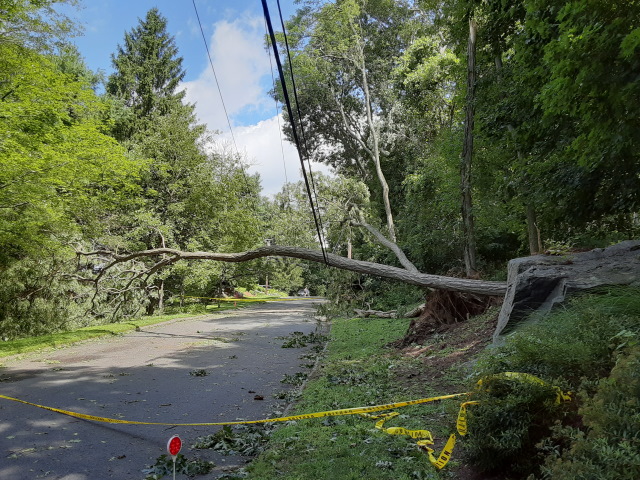
Here's why I was without power for eight days:

two trees on the power lines
It's always here. Irma, Sandy, the October Snow Surprise. There's a rock shelf where several trees staked their roots down decades ago, but the shallow soil has left the trees that grow in this spot vulnerable to high winds. And so, they come down in the big storms.

Fortunately, my home and family were spared. But it was terrible to watch. The winds came out of the south and battered the trees like waves crashing on a beach. This grand red maple in the backyard (picture taken from my garage shortly after it happened) is the closest the damage came to my house.

red maple damaged

A cottonwood crashed across two of my neighbors' yards.

cottonwood down

An ash tree fell from a neighbor's backyard into mine.

ash tree down on rock wall
Two other trees, a maple and a birch, were severely damaged. I don't have pictures at the moment, but if I take them, I'll post them later. A leader on the maple was snapped about fifteen feet off the ground, sending it into a v-notch on a nearby tree. The crown on the birch broke off about forty feet up. It's now dangling by a fragment of xylem.

And yet this is nothing. Hurricane Laura, a category four storm, just tore up Louisiana. Many of those poor souls have nothing left. So for all my griping, I am thankful things weren't worse. If a storm like Laura came through here, the damage would've been incalculble.

\_/
DED

Tuesday, August 11, 2020

Book Review: Xenozoic

book cover for Xenozoic
A global ecological cataclysm has forced mankind underground to ride it out. Five hundred years later, they return to the surface to find it greatly altered. Now dinosaurs, Pleistocene mammals, and things never seen before are roaming the Earth. The survivors have rebuilt old cities or built new ones on top of the ruins of the old. Will they survive in this new age or repeat the mistakes of the past?

I first heard about Xenozoic from the old RPG Cadillacs and Dinosaurs, though I admit that I'd never played it. Still, it looked pretty cool. It was decades later before I found this collection, and it collected dust on my nightstand for a few more years after that. I can't offer a good reason why.

The artwork is all done in black ink. Schultz's talent improves with age, going from very good to fantastic over the course of this collection (1986 - 1996). And if you don't believe me, he won five Harvey Awards with this series, three times for Best Artist or Penciller.

There are two main characters: Jack "Cadillac" Tenrec and Hannah Dundee. Jack has chiselled good looks and a physique to match. He's a mechanic very much in love with 1950s era automobiles (preserved among other things in vaults beneath the surface) and has figured out how to run them on dinosaur guano. He lives in a large garage complex on the mainland and assists the people of the "City in the Sea" (a flooded Manhattan) when he can. But he also has a bit of Tarzan and Henry David Thoreau mixed in. He concerns himself with the balance of nature in this new world, but rather than taking a thoughtful approach, he charges into action because he thinks he knows what's best. Outside of his faithful team in the garage, he tends to alienate others (and annoy this reader).

Hannah Dundee is an ambassador from Wasson (built on the ruins of Washington D.C.). She arrives in the City in the Sea to address a matter of poachers and to foster better relations between the two cities. While she is incredibly attractive, Schultz never stoops to cartoon proportions that are often seen in works tailored for a cis-gendered male audience. She's smart, keenly interested in the scientific potential locked away in the city's library, and politically savvy. She's no damsel in distress either. She rescues Jack from peril just about as often as he rescues her. Their relationship is full of friction as they butt heads over which actions to take in this world. Of course there's also the sexual tension, and one wonders if they're ever going to hook-up.

The world building has some holes in it. For example, dinosaurs in just 500 years? Schultz tries to explain this and other oddities, but the answers don't really work for me. I'd recommend not looking too much into these conundrums and just enjoy the ride. The stories are good, but the artwork is the main attraction here.

Unfortunately, just as the overall storyline was building to confrontation, it went into hibernation. Schultz went to work on other comics and has been working on the Prince Valiant comic strip since 2004. Schultz is 65, so I'm hoping that he returns to Xenozoic someday soon, but there is the possibility that we may never know how it ends.

4 stars.

\_/
DED

Sunday, July 19, 2020

Book Review: Children of Time

book cover for Children of TimeThe epic story of humanity's battle for survival on a terraformed planet.

Who will inherit this new Earth? The last remnants of the human race left a dying Earth, desperate to find a new home among the stars. Following in the footsteps of their ancestors, they discover the greatest treasure of the past age – a world terraformed and prepared for human life.

But all is not right in this new Eden. In the long years since the planet was abandoned, the work of its architects has borne disastrous fruit. The planet is not waiting for them, pristine and unoccupied. New masters have turned it from a refuge into mankind's worst nightmare.

Now two civilizations are on a collision course, both testing the boundaries of what they will do to survive. As the fate of humanity hangs in the balance, who are the true heirs of this new Earth?


The "disastrous fruit" are sentient spiders, ok. Let's get that out of the way right now otherwise this review becomes difficult to write. And this book has been out for five years, so the spoiler window has long been smashed.

There are two storylines here: the spiders and their struggle to evolve from their animalistic origins—thanks to a genetically engineered nanovirus—to building a civilization and human refugees fleeing an ecologically ruined Earth. When telling the story of the spiders, Tchaikovsky adopts the voice of nature documentary narrator as he highlights pivotal moments in spider evolution, biological and cultural. The spiders get names, although these are recycled. Once they're capable of communication, the narration takes a back seat to their conversations. While never abandoning their spiderness, Tchaikovsky imbues the spiders with individual identities, making for reasonably sympathetic characters regardless of one's level of arachnophobia.

Tchaikovsky isn't the first author to craft a sentient spider civilization. One previous story that I've read was A Deepness in the Sky by Vernor Vinge. I read it 15 years ago and don't have a review to refer back to so the details are a bit fuzzy. It was a different first contact story, the spider civilization being something that evolved on its own and the humans visiting their world were there as traders, not colonists. In that book, you saw the spider civilization through their eyes, and it seemed to me like the characters were a bit too humanized with their speech. However, I enjoyed their storyline over the humans. Much like this book.

The human storyline is told through Mason Holsten, the ark ship's "classicist", something of a historian/linguist. He seems disdained by most of the "key crew" as being useless until his skills are needed, and even then he fails to gain much favor, save some grudging respect from the ship's chief engineer, Isa Lain—their relationship was the highlight of the human storyline. The humans spend most of their time in cryosleep as crawling across the galaxy at roughly 1% the speed of light takes a while. Holsten goes in and out of cryosleep over the ship's millennia of travel and witnesses dramatic changes in the ship's personnel with each waking. We're forced to share his disorientation while he gets up to speed. I had some difficulty with him being the protagonist of the human storyline. While I didn't need him to be heroic, I needed a little more moral backbone from him. And maybe some common sense too. He could really be befuddled at times. But while he wasn't the protagonist I wanted, maybe he was the protagonist the human storyline needed.

The "hard choices" that the humans make throughout their storyline really had me rooting for the spiders. I think that was Tchaikovsky's intent. Root for the creepy crawly things because maybe they'll make the right choices because humans really don't seem to know how to do it as they keep making the same mistakes over and over. There are times when Tchaikovsky really drives home this point, offering us a warning that we are really screwing up the planet and ourselves with our behavior.

Initially, I was suspicious of how the ending came together, but after re-reading the points the author made in the narrative through one of the spiders, it made sense. There was a pattern to how the spiders conducted themselves in times of conflict. The final battle between spiders and humans was no different really. That consistency of behavior made it work for me. I think it's hard for us as human beings, the fallible creatures that we are, to accept such an outcome from creatures that we too easily view as monsters. But since we view our own kind as monsters, is it really that surprising?

If there had been some tiny bead present in the brain of all humans, that had told each other, They are like you; that had drawn some thin silk thread of empathy, person-to-person, in a planet-wide net—what might have happened?

4.5 stars

\_/
DED

Friday, June 19, 2020

Book Review: Monstress, Vol. 1: Awakening

boo cover for Monstress Volume 1 AwakeningThe story starts off with a young woman, missing her left arm below the elbow and with a strange tatoo on her chest, being auctioned off to slavery. But rather than getting sold off to some old man for his sexual fantasies, she becomes the property of the Cumaea, an order of women who plumb the boundaries of magic and science. We soon learn that this is part of the young woman's plan. For she has come here seeking answers and a bit of revenge.

The young woman's name is Maika, and she's come to learn what her mother was researching before her death and why she was killed. Maika is an Arcanic, the hybrid offspring of Humans and Ancestors or one of their descendants. Ancestors are familiar earthly animals with humanoid form, blessed with immortality and magic. Their appearance reminded me of the Egyptian pantheon of gods. Some Arcanics like Maika look fully human, but the majority of them have some animalistic traits (ears, tails, wings, etc.) which belie their parentage. Humans consider them to be abominations. There was a savage war between Humans and Arcanics not too long ago, which Maika took part in, and ended in stalemate after a pitched battle near the city of Constantine left over a hundred thousand dead.

There are also talking cats with multiple tails. Some of them wield swords.

This dark fantasy takes place on a world that mixes magic and steampunk technology. Matriarchal societies are in power and wield it ruthlessly, each trying to gain the upper hand on the other. And, of course, there are whispers of "the old gods," cyclopean horrors bent on submitting the world to their appetites. As befits the title, Maika factors into this last one.

The artwork is fantastic. The nuances in facial expressions from one panel to the next convey so much buried emotion. Art deco influences palacial homes, laboratories, and weapons. It's blended with Egyptian heiroglyphics to adorn subterranean tombs. While some of the Arcanic kids are drawn a bit too anime style for me, Takeda makes up for it with the exquisitely rendered monsters and forbidding forests.

Just as there's a wonderful level of detail in the artwork, Liu matches it with character depth. While this is Maika's story, so many other characters are there to provide other POVs to carry the story along. But none of them seem wasted. Each provides some window into this cruel world whereupon we can learn more of its backstory. There are no good guys here, save for the children. Every adult is capable of terrible things, but to balance it out, Liu grants all but the most irredeemable some way to express their better natures.

5 stars.

\_/
DED

Friday, June 12, 2020

Book Review: The Liminal Zone

book cover for the Liminal ZoneNina Buraca, investigator of possible signs of alien life, has heard tales of mysterious events on Pluto's moon Charon, where a science outpost studies extrasolar planets. Facing opposition from her colleagues, she nevertheless travels from Earth to uncover the truth. Once there, she finds herself working with a team of people who have many secrets. To make progress, she has to take sides in an old dispute that she knows nothing about. Can she determine who – or what – is really behind the name "selkies" that the station's staff have given to this uncanny phenomenon?

The Liminal Zone is the third book in Abbott's Far From the Spaceports series, and like the others, it's a standalone. While the first two books (Far From the Spaceports and Timing) featured the same characters, this one introduces us to a whole new cast with a completely unrelated plot. It isn't necessary to read those first two to read this one, but if you like The Liminal Zone, you should check out the others.

For those unfamiliar with this series, humanity has colonized the solar system, and artificial intelligence (AI) has come to fruition. Space travel has improved, it still takes weeks, sometimes months, to travel from one celestial body to another. As such, there's a bit of self-governance each place enjoys, and adults are very much in charge. No dystopia here.

AI entities work alongside humans and have personalities that are barely distinguishable from them. Just as the gods of Mount Olympus suffered from the same emotional shortcomings as humans, so too do Abbott's AIs. As such, people and "personas" work together, live together, and form friendships. They're each other's besties. When Nina announces to her persona, Aquilegia, that she's headed to Charon to investigate the Selkie mystery, the latter balks at going. A fight ensues, and the two of them break-up. As theirs had been a six-year relationship, Nina is devastated and feels very much alone.

All the while that Nina investigates the mystery, her encounters with other people and personas and exploration of the Charon settlement and surface, she can't help but reflect on her feelings. She's the outsider trying to fit in among a group of people. Some are paired up; some work alone. Some are friendly; some stymie her every move to make progress on either the mystery or fitting in. The story is very much an introspective journey as well as an investigative one.

Having a character journey over 30 AUs to find herself may seem unusual, but is it really any different than someone traveling halfway round the world? You go where the path leads you. I confess that I was more interested in the secrets Nina strove to uncover than her personal journey, but I chalk that up to being in a healthy relationship for 26 years. One last thing I'd like to point out is that I haven't read this much about characters drinking tea since Ancillary Justice. I kid. All of this makes for a charming read. Having taken us to the asteroid belt, Mars's moons, and now distant Charon, I'm wondering where Abbott will travel to next.

4 stars

\_/
DED