Friday, September 7, 2018

Book Review: Hellboy, Volume 1 - Seed of Destruction

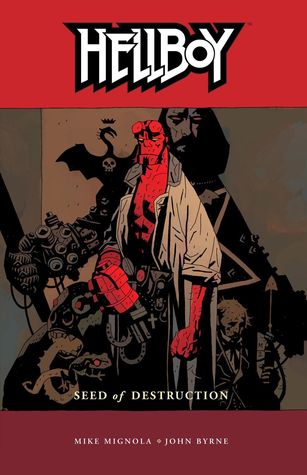
book cover for Hellboy volume 1I saw the Hellboy movie years ago and loved it. Rasputin and the Nazis, Lovecraftian monsters, Gothic ruins, arcane machines, and a wise-cracking, cigar chomping, good demon who kicks ass. I didn't know anything about how Hellboy was supposed to be, but I thought Perlman knocked it out of the park.

I always meant to get around to reading the comic, but I didn't get a chance until now. Starting at the beginning, I see that the movie and the book start off on the same page, but then wildly veer off in different directions with only loose connections as the stories unfold. This is going to be blasphemous of me to say, but I liked the movie more.

In the movie, more time was spent developing the characters and the backstory. In the comic, Hellboy and the reader are subjected to a bad case of monologuing (I've had characters do it, too. It happens to writers all the time.) by Rasputin. As the comic is told almost exclusively from Hellboy's POV—after his origin sequence—there's no other place to put it. Perhaps if this opening story had been told over eight issues instead of four, there might have been a better way to develop it organically.
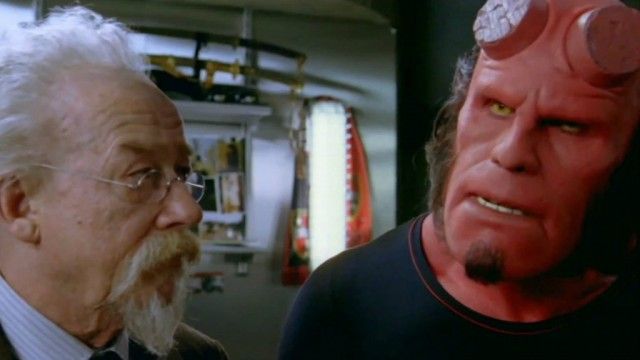
John Hurt and Ron Perlman in a scene from HellboyHellboy's relationships with other characters is largely undeveloped in this issue of the comic. Other than a little background on Abe and Liz, we really don't get any reason why Hellboy cares about them. And Professor Bruttenholm? Forget it. In the movie, Perlman and Hurt really develop the relationship. Here, it's over before it starts with nary a thought or feeling. I have to imagine that these relationships and characters were expounded upon in subsequent issues.

But despite these shortcomings, I liked the story. The Lovecraftian vibe, Rasputin, and occult-Nazis are there with their arcane machines. The Hellboy that Perlman brought to life is a bit more subdued though. The raw power is there, but still in a more embryonic state. There's clearly more to come.

Mignola's art really captures the brooding darkness. Even bright yellow energetic struggles to keep it at bay and won't last long against the suffocating gloom. Sepia tones lend age and authenticity to portraits on a wall. Hellboy pops off the page with his signature fire engine red, particularly when contrasted against the moodier background hues of blue, purple, and gray or contrasting with green-colored foes. And black. Always black.

At the end of this volume, there were a couple notes from Mignola about the origin of Hellboy's appearance, two short four-page comics, and a gallery of Hellboy portraits as interpreted by other artists. It was a nice addition.

3.5 stars.

\_/
DED

Monday, September 3, 2018

Book Review: Altered Carbon

book cover for Altered CarbonFour hundred years from now mankind is strung out across a region of interstellar space inherited from an ancient civilization discovered on Mars. The colonies are linked together by the occasional sublight colony ship voyages and hyperspatial data-casting. Human consciousness is digitally freighted between the stars and downloaded into bodies as a matter of course.

But some things never change. So when ex-envoy, now-convict Takeshi Kovacs has his consciousness and skills downloaded into the body of a nicotine-addicted ex-thug and presented with a catch-22 offer, he really shouldn't be surprised. Contracted by a billionaire to discover who murdered his last body, Kovacs is drawn into a terrifying conspiracy that stretches across known space and to the very top of society.


Biotechnology has advanced far enough that immortality is available for those who can afford it. Consciousness is digitized in "stacks" and stored until a new "sleeve"—an all encompassing term for natural, cloned, or synthetic bodies—is ready. Add to this a diverse menu of drugs that enhance or dull aspects of human physiology. A whole slew of possibilities, noble and illicit, opens up. Death, prison, identity, and sex are all re-defined. The whole system is exploitable, and therein lies the story.

Takeshi Kovacs is an ex-Envoy, a type of Special Forces, who is taken from stack prison on another planet and dumped into a sleeve on Earth. He's been recommended to a billionaire (Laurens Bancroft) to solve his murder. The police say it was suicide, but Bancroft believes he was murdered. If Kovacs can solve the case to Bancroft's liking, the billionaire will purchase his freedom. If not, Kovacs goes back on stack for the rest of his two-hundred-year sentence.

What difference does it make to a billionaire why one of his sleeves died? He claims not to be the suicidal type. He has daily backups, keeps new sleeves on standby, and has already lived 350 years (making him a "meth," short for Methuselah). What's the point of suicide, if he won't remember it when he's downloaded into a new body the next day? Murder makes more sense, which likely means that there's a conspiracy afoot.

As Kovacs sets out to solve the case, he shares his experiences as he gets accustomed to a body that isn't his. Some readers have found this to be oversharing as Morgan is graphic in detail. I saw Kovacs' adjustment as having to go through puberty again. The changes our bodies go through seem alien and strange, and it takes some time before our minds grow accustomed to them and reasserts control. What Kovacs (and others) goes through when entering a new sleeve is no different. It's awkward and discomfiting.

Kovacs' past, both military and criminal, bubbles up in flashbacks, offering glimpses into what shaped his psyche. Underneath the cool, indifferent, tough guy exterior lies a soul that seeks justice for the little guy. The plutocrats can buy their way past the wheels of justice; the poor are ground up like hamburger. And it's that sense of injustice that fuels Kovacs. He internalizes it, makes it personal, and sets off on rampages.

Overall, I have to say I loved it. It's a sci-fi story soaked in noir: Cigarettes and whisky, posh AI-run hotels, a femme fatale, morally corrupt billionaires, and a complicated relationship with the cops. You could also think of it as a much more violent cousin of Blade Runner. Like that film, it also asks questions about the human condition, but doesn't lead to easy answers.

\_/
DED

Monday, August 6, 2018

Book Review: Wool (Omnibus edition)

Book cover for Wool Omnibus editionThis is the story of mankind clawing for survival, of mankind on the edge. The world outside has grown unkind, the view of it limited, talk of it forbidden. But there are always those who hope, who dream. These are the dangerous people, the residents who infect others with their optimism. Their punishment is simple. They are given the very thing they profess to want: They are allowed outside.

The omnibus edition collects what were five separately published parts into one complete volume. I'm glad that I waited as if I had to read each of these parts individually I would've been frustrated. While part one would've been fine as a standalone, parts two through four ended with cliffhangers and so much of the overall story unresolved that I would've felt I'd been played. That's not to say that I didn't like Wool, quite the opposite. From a publishing perspective (and Howey was still indie back then), it's a risky move. You either leave readers clamoring for more (and you'd better deliver!) or you alienate them for selling a story piecemeal.

The first three parts are told from the perspective of a single character (barring the final chapter of part three). And it works. It serves as an introduction to the Silo and what life is like for those living there. Too many POVs might've proved overwhelming for the reader. By focusing on individual storylines, the reader is slowly acclimated to this world that Howey has created. But events transpire in part three that necessitated multiple POVs for parts four and five.

Part one is Holston's tale. A widower, he pines for his recently departed wife and can no longer bear to live without her. He introduces us to the Silo, a massive underground structure where humanity lives after some apocalyptic catastrophe. His actions serve as a preamble for what's to come.

Part two is Mayor Jahns' tale. She's escorted by Deputy Marnes as they journey through the Silo to interview the next sheriff. Besides learning her story, we learn more details about the Silo: It comprises 140 levels, each level serves some function to maintaining life here, and it has its own unique set of politics.

Part three deals with Juliette Nichols, the newly appointed sheriff. Having worked down in Mechanical for a couple of decades, she's not used to dealing with the politics that comes with her new job. She doesn't realize it at first, but she's been stepping on toes since long before becoming sheriff. The head of a rival department is stepping in to fill a power vacuum, and he doesn't like her. The feeling is mutual. As she strives to solve the mystery behind a couple of deaths, she uncovers a secret that threatens to throw the entire Silo into chaos.

Howey does a great job getting the reader to like these characters. You learn so much about them that you can't help but bond with them. They seem familiar, despite their circumstances. Even the antagonist was well drawn for a bad guy. He wasn't wholly evil, just convinced that he knew what was best for the Silo and control must be maintained by any means necessary (a common belief that has led to the downfall of many leaders).

Parts four and five deal with the fallout of Juliette's discovery. All does not go according to the antagonist's plan, and thus contingency plans are put in place to deal with these events. Sinister secrets are revealed, and the nefarious origins of the Silo are dredged up. Two factions struggle for control of the Silo, but one side has a strategic advantage that is unknown to the population at large: It has always been in control.

The ending gave me a bit of a surprise, but I liked it. All in all, it made for a highly entertaining read. Engaging characters, post-apocalyptic setting, secrets to be discovered, decent plot resolution. I can see why it was such a hit. In fact, I wouldn't be surprised if it was made into a TV series. 4 out of 5 stars.

\_/
DED

Monday, July 2, 2018

Book Review: Swords and Deviltry

book cover for Swords and DeviltryThis book contains the origin stories for Fafhrd and the Grey Mouser, the popular pair of adventurers from the mind of Fritz Leiber.

"The Snow Women" is Fafhrd's story. He's all of 18 and it shows. Leiber captures all the raging hormones and misguided idealism of guys that age. Think of this as the barbarian equivalent of Alice Cooper's song "I'm Eighteen" (both were published in 1970 by the way). He has a hot girlfriend, Mara, who loves him dearly, but he's smitten by Vlana, a sultry actress who rides into town with a caravan of entertainers. He's confused. Tired of life in the snow-covered forest, he longs to see the civilized world. So far, his view of the world is as pillager as his tribe of "ice men" ransack towns along the coast as a way of life. Vlana represents his idea of civilization, and his attraction is dual. He wants to bang her, but his mind wants to learn more about the "civilized world" and what it has to offer.

Vlana struck me as being a few years older, if not in age then surely in mind. She knows how the world works and uses her beauty to her advantage. Fafhrd is an open book to her. His naivete about civilization is cute. While she isn't cruel to him, she does play him to her advantage.

Mara knows that Fafhrd lusts for Vlana. She doesn't buy the whole civilization line he tries to sell her. It pisses her off (rightly so!), and she's torn between kicking Fafhrd's ass and forgiving him.

The arrival of the caravan is an annual event organized by the men of the tribe. There are acting performances with musical accompaniment, but it's primarily striptease. The men are dogs and are dumb about barring the women from watching. The women of the tribe resent it. They've resorted to witchcraft and ice-laden snowballs to interfere with the show and wrest their husbands and sons away. It's gone on for so long that the grudge has festered. Fafhrd's mother, bitter from her husband's death while mountain climbing, is their leader. She's strong with the dark arts and continues to escalate the conflict. Fafhrd feels smothered by her. In turn, he feels like Mara is turning into his mother.

"The Unholy Grail" is the Grey Mouser's origin story. While serving as an apprentice to a wizard, he came to meet the local duke's daughter Ivrian. Love blossomed for a time, but Mouser knew of the duke's disdain for him and the wizard. He returned one day from an errand to find the wizard dead and his home burned. From here, the Mouser's tale becomes all about vengeance.

As for Ivrian, she's torn between helping Mouser and obeying her cruel father. He verbally abused her often, comparing Ivrian to her deceased mother and how drastically she fell short. It isn't pretty; and the emotional abuse has left Ivrian scarred and fearful of her father's wrath. There are few things worse for a child than to grow up with abusive parents, so criticism of Ivrian's alleged weakness should be tempered accordingly.

"Ill Met in Lankhmar" is where our two heroes' stories come together. Each is eyeing a group of thieves on their way back to the guild with a successful haul, but they're unaware of each other. As fate would have it, they simultaneously attack the thieves. But rather than fight over the spoils, they see something in the other that draws them together. They decide to celebrate their success and new found friendship by getting drunk and introducing the other to their girlfriends. But the Thieves' Guild isn't about to take this affront lying down.

I enjoyed Leiber's writing style. I think the bookgator said it best: "Reading these stories feels a little like sitting at the feet of an old, old storyteller while he reminisces about childhood heroes." And I couldn't agree more.

3.5 stars

\_/
DED

Tuesday, May 29, 2018

Book Review: Armor

book cover for ArmorThe planet is called Banshee. The air is unbreathable, the water is poisonous. It is home to the most implacable enemies that humanity, in all its interstellar expansion, has ever encountered.

Body armor has been devised for the commando forces that are to be dropped on Banshee—the culmination of ten thousand years of the armorers’ craft. A trooper in this armor is a one-man, atomic powered battle fortress. But he will have to fight a nearly endless horde of berserk, hard-shelled monsters—the fighting arm of a species which uses biological technology to design perfect, mindless war minions.

Felix is a scout in A-team Two. Highly competent, he is the sole survivor of mission after mission. Yet he is a man consumed by fear and hatred. And he is protected, not only by his custom-fitted body armor, but by an odd being which seems to live within him, a cold killing machine he calls “The Engine.”

This is Felix’s story—a story of the horror, the courage, and the aftermath of combat, and the story, too, of how strength of spirit can be the greatest armor of all.


The story starts out with what you'd expect after reading the book blurb (Goodreads or paperback): a non-stop brutal assault. Felix is but one soldier of thousands dumped on Banshee, the alien homeworld, to fight the enemy on their turf. While not stated outright, they're treated as disposable heroes. Lessons are never learned. Tactics never change. Mistakes are repeated, sending the casualty count higher and higher. Published in 1984, I wonder if the hangover from Vietnam factored into Steakley's writing.

Felix's battles are epic, but there's no glory here. The "ants"—giant, mass-produced, mindless biological killing machines—relentlessly attack Felix and his fellow soldiers. Swarm after swarm come at them, and eventually, everyone dies. Except Felix. Steakley writes up Felix's battles in gory detail, which wears on the reader, but that's his point. He wants you to connect with Felix, who is physically and psychologically drained from all the killing, watching his comrades die, and being ordered to repeat the process over and over and over. It's madness, and it threatens to take Felix down with it. He's too afraid to live, but too angry to die.

But in the second part of the book, we shift from Felix to Jack Crow, interstellar celebrity rogue. He violently escapes from prison to a starship on a landing pad, only to be caught up with a group of mutineers. He's coerced into working with them in a scam to secure more fuel from a Fleet Scientific Colony. Jack is to use his celebrity status to his advantage to get the mutineers past the planet's defenses. Jack uses his reputation and charisma to gain audience and then presents a Trojan Horse of sorts to the project's chief scientist, Hollis Ware. Not only does it snare Hollis's curiosity, but Jack's too.

This second story takes over for quite a large chunk of the book, but Felix isn't forgotten. Steakley eventually weaves the two storylines together, and we learn more about what happened to Felix as well as his past before enlisting. Along the way, Steakley works on evolving Jack from selfish to selfless in a way that remained true to the character.

There are a few women characters of note in the book, and each is treated differently. Forest is a soldier just like Felix. She's fantastic: smart, brave, and skilled. Colonel Canada seemed like someone fresh out of college: book smart and eager, but not all that experienced. When she appears, it's like an episode of Spring Break: Banshee. Lya is a psychologist and Hollis's handler, not to mention very much in love with him. Karen is the Project Administrator and...wow. Let's just say that when we learn her backstory, it strikes a chord with the #metoo movement. All four impact either Felix or Jack in some way that shapes their worldview.

There's been a lot of comparison of this novel to Starship Troopers and The Forever War. Yes, there are big mean bugs that attacked Earth (ST), and there's a bleak outlook on the futility of war and those calling the shots (FW), but there are major differences. ST was more about patriotism and duty as Heinlein saw a moral decline in 1950s America. Armor rejects patriotism as an excuse for stupidity. FW was a mirror of Haldeman's experiences fighting in Vietnam and the difficulty returning to civilian life. Armor acknowledges it, but forges a different path, concerning itself with the toll taken on the human psyche.

There are some parts, including the ending, that beg for further story exploration. Sadly, Steakley died in 2010 from liver disease, having never completed a sequel.

Overall, a fantastic book (please ignore the typos) that worked for me on numerous levels. 5 stars.

\_/
DED

Monday, May 7, 2018

Book Review: Burning Chrome

Book cover for Burning ChromeNewer editions have better covers. This was the 1987 cover, which is the one I own.

This is a short story collection of Gibson's early work, ranging from 1977-1985. In it, he lays the groundwork for his Sprawl trilogy, which includes Neuromancer, Count Zero, and Mona Lisa Overdrive. But more importantly, he gave sci-fi a much needed boost in the arm by securing the foundation of what would become known as cyberpunk.

One has to remember that during the time that Gibson wrote these stories, the internet was a domain limited to a select few militaries, government institutions, and universities. The web didn't even exist until 1991. But he saw the potential of where it could lead. While his biotech visions are just starting to show signs of emergence, by and large, he got his computer technology right.

First up is "Johnny Mnemonic." How a 22-page short story led to the movie of the same name is beyond me. It's like the studio cherry-picked several elements from the story that they liked and came up with something else entirely. This story is fine. It rushes by so fast, everything is lost in the world building. I had to re-read a couple of passages as the segues were easily overlooked.

The story was published in 1981, it helped define a cyberpunk future that fortunately hasn't come to pass, though some of the technological elements ring true. Though with the ubiquity of high-density, tiny storage devices (i.e. thumb drives), requiring someone to have wetware for a few megabytes of info is quaint. Tera- or Petabytes would've impressed.

"The Gernsback Continuum": While on assignment, a photographer starts hallucinating about a future that was forecast in the 1930s.

"Fragments of a Hologram Rose": Trying to put a broken heart back together with holograms in a ruined American landscape.

Gibson co-wrote "The Belonging Kind" with John Shirley. In this one, a socially awkward man is smitten by a woman at a bar. As he follows her through the city, he soon learns that she's more than she appears to be, which only makes her even more intriguing.

In "Hinterlands," humanity accidentally stumbles upon interstellar travel, but it's really rough on the people that experience it. There's a team at the L5 station that do their best to help those that come back. It's about as easy as putting a broken egg back together.

After cornering the oil market, the Soviet Union forced the US to concede human spaceflight in "Red Star, Winter Orbit", co-written with Bruce Sterling. Colonel Komarov, the first person on Mars, calls the Soviet space station home, but after two decades in space, it's also a prison. Returning to Earth's gravity would crush him, but that's exactly what the government wants.

"New Rose Hotel": Being a headhunter in the biotech market is a ruthless business. Like love, there's nothing that stings more than betrayal. Substitute thumb drives for diskettes and you'll be ok.

"The Winter Market": When dreams sell like popular music does today (or yesterday), it'll give rise to its own rock stars, complete with their own tragic stories.

In "Dogfight," co-written with Michael Swanwick, a loser drifter decides that he's going to make his mark by being the best holovideogame player in the whole podunk town, and he's willing to do anything to accomplish it, even if it means being a dick.

"Burning Chrome" wraps up this collection with the quintessential cyberpunk story: Two console jockeys set out for that one final score that'll make them rich. To do it, they'll need to take down a criminal kingpin via the internet matrix.

The first three stories are too obsessed with describing Gibson's world and throwing cool, new jargon at the reader than in crafting good stories. Style over substance. But after that, the real storytelling begins. Gibson eases off the nuevo lingo, particularly when writing with others, to develop the characters into people we can recognize beneath the veneer of tech. Definitely worth checking out to see a successful writer when he was still hungry and passionate about writing down his vision of the future.

\_/
DED

Friday, April 27, 2018

I Killed MySpace

MySpace logo
No, not really. It's just a coincidence that the #1 social networking outlet went into decline shortly after I joined up. It's also very much alive, albeit largely irrelevant in the social media landscape, as a music and entertainment platform.

I resisted joining for years, but I finally gave in to peer pressure. While I was connecting with obscure indie metal bands, scandals rocked the platform. It was labelled a "vortex of perversion" after sensationalized stories of teen sex, drugs, and kidnapping surfaced, reinforced by unsavory ads that everyone could see regardless of age and "moral standing." Throw in technical difficulties and the platform quickly hemorrhaged users. If you want, you can read a thorough story here.

MySpace was displaced by Facebook, and the rest is history.

I'm still not on Facebook. Why? So many reasons, but they can be categorized into two camps: the politics of personal relationships and Facebook's use of my data. I think both are pretty self-explanatory, but I'll elaborate.

The politics of personal relationships requires that I friend people who I don't like or don't really connect with in real life. And then I have to like things that they post like "sitting on the couch with a bag of Doritos watching TV" or "here are 32 pictures of my kid". Some people don't understand the concept of oversharing. In either case, if I don't play along, I'm a dick. When I see them in person, I then have to explain why I didn't "like" their post or refused their friend request. Makes for some really awkward times. I much prefer to be polite and keep my interactions with them in small doses.

If that makes me seem like a jerk, I'll accept that. But one should bear in my mind, that politeness in uncomfortable situations keeps things civil. Human history is rife with violence. The polite veneer of civility helps us all get along, but it can be exhausting. Do I really need to play this game with people who overshare? Do we really need more drama?

Facebook uses its members' data to make money. Nothing is off limits. It seems like people are just waking up to this. The counter argument is that you can't something for nothing. Yeah, I get that. I'd pay a reasonable subscription for a social media platform (I already pay for my website) where I had full control over how my data was used. But nothing sells like FREE.

I'll spare you the whole fake news crap that surfaced during the last election. Like I want to have a page of lies clogging up my screen.

So why am I considering joining? Because nearly everyone is on there! That isn't hyperbole: 40 million businesses, 2 billion people. Start up companies (breweries come to mind) forego having websites in favor of a Facebook page due to cost and simplicity. But even mature businesses have a presence on Facebook to drum up interest and will use it to handle their communications.

As an indie author, I need to find ways to reach out to people. Websites and blogs are just islands in the vast sea of the internet. Facebook is a continent. If you don't have some connection, you won't necessarily die, but you won't flourish either. If one person likes something, it shows up in their feed, which their friends see. Some might actually follow up and see what their friend liked. Such is the power of the network.

I've tried two other social media platforms (besides MySpace), but neither compares to the Pangaea of Facebook.

Google+ is fine, but its activity is tepid. Yes, I realize that Google is using my data, but I'm careful about what I share. Also, I haven't had any of the liking pressure. Of course, nearly no one I know uses it. I keep wondering when Alphabet is going to pull the plug on it.

Goodreads is a haven for bookworms. Its defined structure means I don't have to worry about drowning in cat videos. Again, no pressure to like someone's review or update. But maybe that's because I don't have a big network of people I connect with there. That's not to say it doesn't have issues, but I haven't had a problem avoiding them. It also offers authors a means to self-promote. I haven't taken full advantage of them yet, but plan to once I finish Gateway to Empire. Maybe that will be enough, but I'm inclined to think not.

But maybe this angst is all for naught. There's anecdotal evidence that Facebook usage is in decline. By the time I get around to joining it, maybe all of its issues will have finally caught up to it and send the company down into a death spiral. I don't think so. It's too big to fail, and there aren't any real alternatives. Unless there's an anti-social media movement where we downplay the importance of its role in our lives, I don't see that happening.

So I guess I'd better get ready to like a lot of cat videos and baby pictures.

\_/
DED