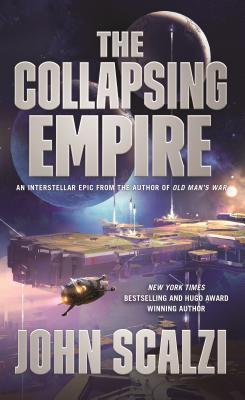
 Our
universe is ruled by physics. Faster than light travel is impossible—until the discovery of The Flow, an
extradimensional field available at certain points in space-time, which can take us to other planets around
other stars.
Our
universe is ruled by physics. Faster than light travel is impossible—until the discovery of The Flow, an
extradimensional field available at certain points in space-time, which can take us to other planets around
other stars.
Riding The Flow, humanity spreads to innumerable other worlds. Earth is forgotten. A new empire arises, the Interdependency, based on the doctrine that no one human outpost can survive without the others. It's a hedge against interstellar war—and, for the empire's rulers, a system of control.
The Flow is eternal—but it's not static. Just as a river changes course, The Flow changes as well. In rare cases, entire worlds have been cut off from the rest of humanity. When it's discovered that the entire Flow is moving, possibly separating all human worlds from one another forever, three individuals—a scientist, a starship captain, and the emperox of the Interdependency—must race against time to discover what, if anything, can be salvaged from an interstellar empire on the brink of collapse.
Books-A-Million (BAM!) had the entire trilogy on sale when I visited the Bangor, Maine location in May. I mention that because it was a totally random stop meant to kill time while my son wrapped up some post-college graduation activities. They had it for a price that I couldn't refuse. The store is located in the Bangor Mall commercial park, a solar system of stores orbiting the dying mall—watch out for the potholes!—at its center. And IIRC, BAM! is planning on re-locating to a commercially healthier part of the city. Every time we visit, I wonder how much longer it'll last. But unlike dying stars, it'll skip the supernova, just collapse in on itself like a black hole, possibly take the entire commercial park with it.
But I digress.
The book blurb tells you that humanity's means of FTL interstellar travel is unraveling. This is not good for business or humanity's survival. In the past, worlds that lost access to the Flow have died—for some reason the Flow predominantly only goes to worlds where atmospheric conditions are toxic to humans, thus forcing them to live in artificial constructs. And the economy is controlled by family-owned megacorporations who have been granted monopolies over segments of the economy. So we have insanely rich people behaving badly, always trying to get an edge over rival houses, politically and economically. This super secret information about the Flow is something that can give a clan an edge and thus is something that they're willing to kill for.
But as serious as that sounds, Scalzi includes a measure of his humor, brought out by the characters' dialogue, most notably through the corporate executive (Kiva) who carpet f-bombs people who annoy her. And there are characters who demonstrate relatability despite their positions. Cardenia has to become emperox as she's the only living heir to the throne, but she has spent her whole life living like a regular person, away from the trappings of royalty. And Claremont, a humble science teacher, has to take his father's work on the Flow and present it to the emperox and the other branches of government and get them to act now before it's too late.
At this point in his career, John Scalzi is comfortable. He has a solid fanbase that can be counted on to buy his books and thus keep his publisher happy. And happy publishers make authors' lives easier. Having mastered the formula that keeps his readers devoted and said publisher happy, he's not going to mess with that. So if you like Scalzi's past work, then it's highly likely you'll like this one too. But you have to go into this knowing that it's a series, and it won't get wrapped up until the last book. There will be unresolved bits when this book ends. I was fine with it, but not everyone will.
4 stars
\_/
DED

 This
is the last installment in the Cities in Flight series, and it presents the most dire problem for
Amalfi and company: the end of the universe.
This
is the last installment in the Cities in Flight series, and it presents the most dire problem for
Amalfi and company: the end of the universe. In this,
the third book in the Cities in Flight series—but the first one to be published—Mayor John
Amalfi leads the city of Manhattan through several adventures.
In this,
the third book in the Cities in Flight series—but the first one to be published—Mayor John
Amalfi leads the city of Manhattan through several adventures.
 Chris
stood on the outskirts of Scranton, PA, hoping to watch it take off to join the multitude of cities that
had left Earth for the stars (natural resource depletion being the #1 driving force for said exodus),
but an
Chris
stood on the outskirts of Scranton, PA, hoping to watch it take off to join the multitude of cities that
had left Earth for the stars (natural resource depletion being the #1 driving force for said exodus),
but an 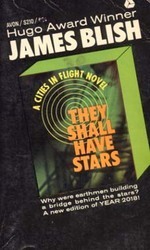 2018 AD.
The time of the Cold Peace, worse even than the Cold War. The bureaucratic regimes that rule from Washington and
Moscow are indistinguishable in their passion for total repression. But in the West, a few dedicated individuals
still struggle to find a way out of the trap of human history. Behind the screen of official research their
desperate project is nearing completion...
2018 AD.
The time of the Cold Peace, worse even than the Cold War. The bureaucratic regimes that rule from Washington and
Moscow are indistinguishable in their passion for total repression. But in the West, a few dedicated individuals
still struggle to find a way out of the trap of human history. Behind the screen of official research their
desperate project is nearing completion... Larry
Niven is most well known for his Ringworld series. Therein, he established his hard sci-fi credentials
with his elaborate world-building, an artificially constructed ring around a star providing enough livable
surface area equivalent to thousands of Earths. And true to form, this book's strength is its
world-building. It posits a star system composed of a G-class star in orbit around a neutron star.
Closer in, the neutron star has a doughnut-shaped ring of gas fed by a gas giant, whose atmosphere
is slowly being stripped by said neutron star. Life exists here in the form of kilometers-long
trees, shaped like integrals (you know, the kind from Calculus), inhabited by alien birds and
insects. Free floating ponds (giant spheres of water) occasionally crash into the trees, providing
life sustaining water.
Larry
Niven is most well known for his Ringworld series. Therein, he established his hard sci-fi credentials
with his elaborate world-building, an artificially constructed ring around a star providing enough livable
surface area equivalent to thousands of Earths. And true to form, this book's strength is its
world-building. It posits a star system composed of a G-class star in orbit around a neutron star.
Closer in, the neutron star has a doughnut-shaped ring of gas fed by a gas giant, whose atmosphere
is slowly being stripped by said neutron star. Life exists here in the form of kilometers-long
trees, shaped like integrals (you know, the kind from Calculus), inhabited by alien birds and
insects. Free floating ponds (giant spheres of water) occasionally crash into the trees, providing
life sustaining water.