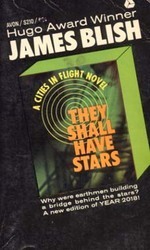
 2018 AD.
The time of the Cold Peace, worse even than the Cold War. The bureaucratic regimes that rule from Washington and
Moscow are indistinguishable in their passion for total repression. But in the West, a few dedicated individuals
still struggle to find a way out of the trap of human history. Behind the screen of official research their
desperate project is nearing completion...
2018 AD.
The time of the Cold Peace, worse even than the Cold War. The bureaucratic regimes that rule from Washington and
Moscow are indistinguishable in their passion for total repression. But in the West, a few dedicated individuals
still struggle to find a way out of the trap of human history. Behind the screen of official research their
desperate project is nearing completion...To be honest, I thought the iconic Boston album cover was inspired by the Cities in Flight series, of which They Shall Have Stars is the first in the series. But I can find no evidence of that.
For old science fiction, this one had some elements to it that were surprisingly not dated. There were female characters—one major, one minor—that held technical jobs. Both were described as being rather plain instead of being made to uphold the era's standard of beauty. One woman's Latin name was just that, a name, as "such once-valid tickets no longer meant anything among the West's uniformly mixed-race population." Blish was apparently downright progressive for his time.
While paper is still a thing, robots can be operated remotely via VR gear. "Believer" terrorists spray gasses at people to induce feelings of euphoria or shame. Fireworks can be designed to bring sparkling messages to the sky.
Published in 1956, Blish was living in an America deep in the Cold War and infected by McCarthyism. So he took that fear and paranoia and ran with it. Domestic spying is rampant, and everyone, including Congressmen, has to watch what they say and do lest they be tossed in prison. But there's one senator that's determined to restore freedom to his fellow Americans.
But Big Science is still a thing. There's a "bridge to nowhere" down in the depths of Jupiter being used for scientific study and experiments. Remote workers on Jupiter's moons use VR to control robots on the bridge to affect repairs in the gas giant's tumultuous atmosphere. The experience can be off-putting and tends to stress out the workers.
And some astronaut has retrieved soil samples for a pharmaceutical company in hopes of discovering something useful to aid mankind. He's miffed that no one at the company is dropping everything to attend to him. While waiting he gets suspicious that there's something going on at the company. Impatient with waiting, he gets downright mean with a receptionist, and it takes a while for him to stop being an ass.
These three plotlines take nearly the entire length of this short novel (novella by today's standards) to bear fruit. I couldn't figure out where any of them were leading or how they were connected until the big reveal. The astronaut's work with the pharmaceutical company offered some clues, but the disgruntled bridge worker's story was just so much angst. If the individual storylines did more, then I would've liked it more.
3 stars
\_/
DED

 Larry
Niven is most well known for his Ringworld series. Therein, he established his hard sci-fi credentials
with his elaborate world-building, an artificially constructed ring around a star providing enough livable
surface area equivalent to thousands of Earths. And true to form, this book's strength is its
world-building. It posits a star system composed of a G-class star in orbit around a neutron star.
Closer in, the neutron star has a doughnut-shaped ring of gas fed by a gas giant, whose atmosphere
is slowly being stripped by said neutron star. Life exists here in the form of kilometers-long
trees, shaped like integrals (you know, the kind from Calculus), inhabited by alien birds and
insects. Free floating ponds (giant spheres of water) occasionally crash into the trees, providing
life sustaining water.
Larry
Niven is most well known for his Ringworld series. Therein, he established his hard sci-fi credentials
with his elaborate world-building, an artificially constructed ring around a star providing enough livable
surface area equivalent to thousands of Earths. And true to form, this book's strength is its
world-building. It posits a star system composed of a G-class star in orbit around a neutron star.
Closer in, the neutron star has a doughnut-shaped ring of gas fed by a gas giant, whose atmosphere
is slowly being stripped by said neutron star. Life exists here in the form of kilometers-long
trees, shaped like integrals (you know, the kind from Calculus), inhabited by alien birds and
insects. Free floating ponds (giant spheres of water) occasionally crash into the trees, providing
life sustaining water.
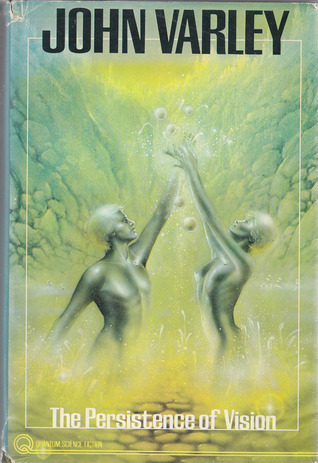 This
is a collection of short stories John Varley wrote in the 70s. Most of them take place in the same universe—the
Eight Worlds universe—as his novel, The Ophiuchi Hotline. So those stories make use of memory
recordings, cloning, commonplace sex changes, nullfields, AI, and humanity's exile from Earth.
This
is a collection of short stories John Varley wrote in the 70s. Most of them take place in the same universe—the
Eight Worlds universe—as his novel, The Ophiuchi Hotline. So those stories make use of memory
recordings, cloning, commonplace sex changes, nullfields, AI, and humanity's exile from Earth.
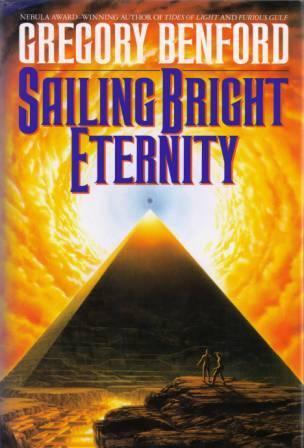 If you
made it this far into the series, congratulations. Whether or not you'll like how it ends is a bit of a coin toss.
If you
made it this far into the series, congratulations. Whether or not you'll like how it ends is a bit of a coin toss.
 West
Germany, 1949. Former actor Max Kaspar suffered greatly in the Second World War. Now he owns a nightclub in
Munich—and occasionally lends a hand to the newly formed CIA. Meanwhile, his brother Harry has ventured
beyond the Iron Curtain to rescue an American scientist. When Harry is also taken captive, Max resolves to
locate his brother at all costs. The last thing he expects is for Harry to go rogue.
West
Germany, 1949. Former actor Max Kaspar suffered greatly in the Second World War. Now he owns a nightclub in
Munich—and occasionally lends a hand to the newly formed CIA. Meanwhile, his brother Harry has ventured
beyond the Iron Curtain to rescue an American scientist. When Harry is also taken captive, Max resolves to
locate his brother at all costs. The last thing he expects is for Harry to go rogue.
 Trying
to escape the relentless mechs, the last humans from the planet Snowglade take their ancient starship on a
dangerous course straight into the Eater, the black hole at the galactic center. Hungry and desperate,
the refugees begin to question the leadership of Captain Killeen, who believes the center holds their
one hope of survival. Meanwhile, Killeen's son Toby struggles with the microchips that were implanted
in his spine—a technology that now threatens his sanity. Caught between their genocidal
pursuers and peril in the galactic center, Killeen and Toby bring humanity to its final destiny.
Trying
to escape the relentless mechs, the last humans from the planet Snowglade take their ancient starship on a
dangerous course straight into the Eater, the black hole at the galactic center. Hungry and desperate,
the refugees begin to question the leadership of Captain Killeen, who believes the center holds their
one hope of survival. Meanwhile, Killeen's son Toby struggles with the microchips that were implanted
in his spine—a technology that now threatens his sanity. Caught between their genocidal
pursuers and peril in the galactic center, Killeen and Toby bring humanity to its final destiny.
 Galactic
Center series book #4.
Galactic
Center series book #4.