 When I picked up this graphic novel from the library, I had no idea who Jonathan Ames was. Upon further investigation, I'd never even heard of any of his works, be they book, film, or TV show, save one (Blunt Talk). But even that one show I've never seen and only knew of it because Patrick Stewart played the titular role.
I gathered from the liner notes that this was the fictionalized memoir of a writer (Jonathan A.) who struggled with alcohol. Having had my own wanderings down that path over a number of years—luckily changing course before it was too late—I was curious to hear his story, even if there was a bit of fiction in it.
For the sake of simplicity, I'm going to refer to the fictional Jonathan A. as the author, Ames.
Ames explores how alcohol played a role throughout his life. Like many, his relationship started in high school. Alcohol is that wonderful social lubricant that helps combat the terrifying awkwardness of being a teenager, a human being. But alcohol didn't like Ames, and it kicked his ass. Ames ignored it though; the euphoria that came with drinking was worth it to him. And when various relationships with family, friends, and girlfriends turned sour, alcohol was there to get him through it. While he had periods of sobriety, there was always something to trigger a relapse, sometimes into harder drugs.
Ames takes us from high school parties in New Jersey to starry beaches in Bequia. He relives sexual escapades, detoxing, and the emotional fallout of 9/11. Dean Haspiel's black and white artwork perfectly encapsulates each scene, clearly conveying the emotions that Ames' character is feeling.
Although fictionalized, it still feels like Ames is telling an honest story, but only to an extent. He tries to balance the melancholy with humor, but when the latter wanders into the scatological, it took away from the sympathy I'd felt for the character. The ending seems rushed. The epiphany Ames experienced might be true, but I was left unconvinced that it would stick. An earlier epiphany after 9/11 was forgotten after a chance encounter with Bill Clinton went straight to the character's head. But the very last page has me thinking that no epiphany will ever suffice until the void in his life is filled.
3 1/2 stars.
\_/
DED

 I saw the
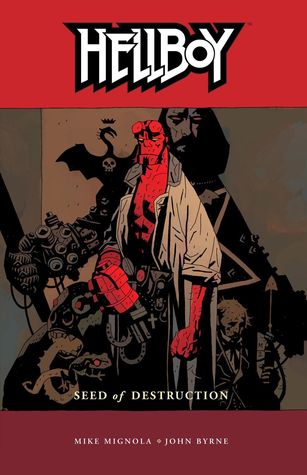
 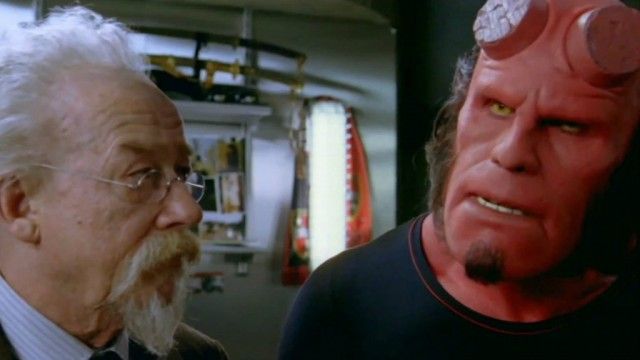 Hellboy's relationships with other characters is largely undeveloped in this issue of the comic. Other than a little background on Abe and Liz, we really don't get any reason why Hellboy cares about them. And Professor Bruttenholm? Forget it. In the movie, Perlman and Hurt really develop the relationship. Here, it's over before it starts with nary a thought or feeling. I have to imagine that these relationships and characters were expounded upon in subsequent issues.
 Four hundred years from now mankind is strung out across a region of interstellar space inherited from an ancient civilization discovered on Mars. The colonies are linked together by the occasional sublight colony ship voyages and hyperspatial data-casting. Human consciousness is digitally freighted between the stars and downloaded into bodies as a matter of course.
 This is the story of mankind clawing for survival, of mankind on the edge. The world outside has grown unkind, the view of it limited, talk of it forbidden. But there are always those who hope, who dream. These are the dangerous people, the residents who infect others with their optimism. Their punishment is simple. They are given the very thing they profess to want: They are allowed outside.
 This book contains the origin stories for Fafhrd and the Grey Mouser, the popular pair of adventurers from the mind of Fritz Leiber.
 The planet is called Banshee. The air is unbreathable, the water is poisonous. It is home to the most implacable enemies that humanity, in all its interstellar expansion, has ever encountered.
 Newer editions have better covers. This was the 1987 cover, which is the one I own.